

Superform and supermeme. Thoughts on Thomas Bayrle’s art and meme culture
04/24/2026
7 min reading time


1967 – an episode of the “Spider-Man” comic series is broadcast from which, some 50 years later, an image was taken that formed the basis for a meme that went viral. That same year, Thomas Bayrle started making silkscreens of mass-produced consumer items, centering on the compositional principle of the “superform.” Just a coincidence?
The mimetic “You, too” structure of the meme
Step 1: We start out by selecting a “meme template.” It should appeal to the masses and also give each individual an opportunity to find themselves reflected in it. So, let’s take Spider-Man: a superhero figure in pop culture who functions as someone to identify with and a commonplace in equal measure. Over and above this relationship of individual and mass, the image, for its part, is relatively insignificant and replaceable. The three figures point at each other, and what this actually has to do with us is initially unclear – a potential meme.
Step 2: We replace the Spider-Man heads with Thomas Bayrle’s head and add a picture caption. The meme’s significance becomes clear and something concrete is stated. From the mass of possible experiences the meme could express, we now discern a single, personal experience, that can itself be shared and thus transformed into a shared experience.
Step 3: We share the meme (in this case with you, the SCHIRN MAG readers). What, until that point, was only a potentially shared experience now becomes a reality. Through the sharing of the meme, its “You, too” moment is triggered with the suggestive statement the image conveys: “You, too, saw the exhibition in the SCHIRN and know what we are getting at.” The offering of an experience is now there, ready to be spread.
A few more explanations are probably in order. Before you start thinking that we simply want to confuse you, let’s finally get round to talking about Thomas Bayrle and the superform.


The superform’s memetic qualities
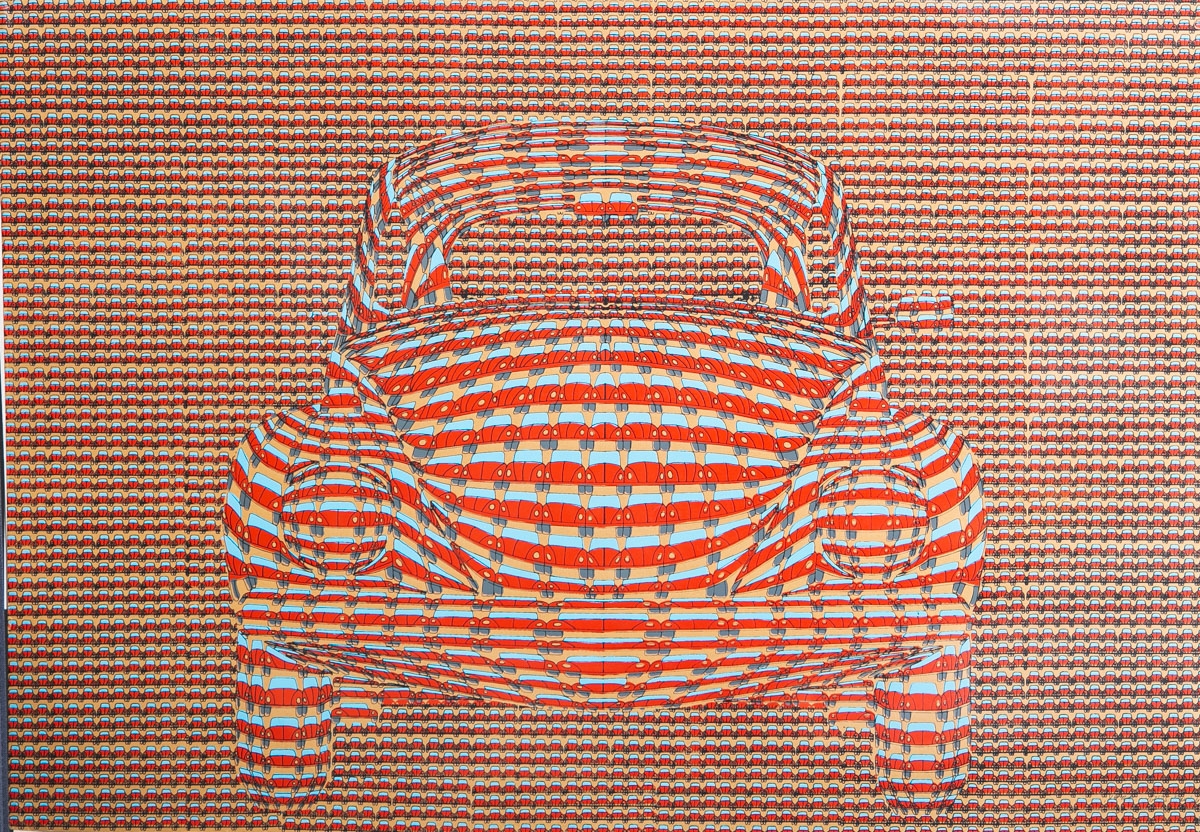
After all, we already know this three-step process from Bayrle’s superform. It gives rise to an overall image through the repeating and interweaving of one single motif which, in turn, often represents the same thing as the overall image, as is the case in his well-known 1969 series of VW Beetles.
As we have seen, in the case of a meme, an ostensibly personal experience is shown to have a mass underbelly. The production of an image also comes into play with the superform, but in a way that visualizes it as a mass phenomenon; hence, the contours of the personal can only become apparent through their mass repetition. The mass is reinforced by the repetition of the personal but always remains in the background, and the personal can only appear in the first place against that background.
In other words, the superform is not only a compositional pictorial principle but the critical visualization of a logic of production. Bayrle’s repetitive image form reflects the market logic of post-war economic reconstruction in West Germany – a logic that conveyed a sense of freedom through the consumption of mass-produced commodities. Here, the superform reflects how the mass production of commodities goes hand in hand with a consumable way of life. Goods exude meanings, fantasies, and wishes that are accepted and embodied in consumerism or the drive to consume, and thus enable the individual to identify and position themselves, and thus to communicate. Bayrle often uses the theme of the car, which is a prime example of this. What counts is the symbolic character, the commodity as image. The superform draws attention to precisely this image status and shows how human relationships are replaced by their relationships to the commodity as image object. Individuality becomes visible as something mass-produced.

Who is pointing at whom here?
If the superform thus critically shows us how the image-based organization of society reinforces the masses in the name of individuality, what then does this imply for the meme? How can we look at memes through the critical lens of the superform? In this regard, the purportedly personal experience shared through the meme is actually the repetition, imitation and standardization of a mass-circulated way of perceiving the world. The meme is likewise merely consumed. The “You, too” statement only points in one direction, for here the shared offer moves from me to you, from us to you others, without ever really becoming personal. It is therefore hardly surprising that in the “Fröhlich sein!” (Be happy!) exhibition, Bayrle’s motifs refer directly to meme culture.
We increasingly encounter smartphones in Bayrle’s latest superforms, meaning the technology of memetic reproduction. While earlier motifs were fueled by advertising and consumer culture (beer brands, car marques, etc.) and thus themselves functioned as proto-memetic entities, now the terminal itself comes into play, the device that keeps the flickering digital image worlds alive. It is presumably not a coincidence that the image production of the superform is reminiscent of the way a display functions, and the way images (and thus memes, too) are composed from countless pixels. Unlike modern displays, where this mode of production disappears completely into the background, Bayrle clearly shows us precisely this principle. His reference to the technological basis of the process of reproduction by digital media emphasizes the materiality of the impersonal individuality of the world of memes and the technological-infrastructural power relationships. Today, the question is less about authorship and image content and more about how management, control, and organization are reinforced by the technologies of the digital media.
Retrospectively, Bayrle’s superform is a kind of visual offering on theory that already preempts any critique of the meme culture. By highlighting the mass production of the purportedly personal, it deciphers the origination of shared experiential worlds through their memetic repetition: In the meme, the personal has a mass basis from the outset in order to serve as the basis for a shared horizon of experience – which then, for its part, reproduces the “personally true.”
We could broaden this out and ask what is actually conveyed by the memetic “You, too” principle – or, in other words: Who is pointing at whom here? It is not a blank face that lurks behind the Spider-Man mask but an actual perspective, although which perspective is a matter for another, no less confusing article.
