

Personal Jesus. Thomas Bayrle and the (Old) Masters
05/07/2026
17 min reading time
During his thirty-year tenure at the Städelschule, Thomas Bayrle inspired up-and-coming artists. A lifelong student of art history himself, he was greatly influenced by history’s most iconic works. Here are 10 works by Thomas Bayrle and their art-historical references.
1
Thomas Bayrle
“iPhone Pietà” (2017)
The inspiration for Thomas Bayrle’s “iPhone Pietà” (2017) is instantly recognizable as Michelangelo’s “Madonna della Pietà” (1498–1499). Much like its mononymous creator, this iconic statue of the Italian High Renaissance is most often simply referred to as “The Pietà”. It shows an unusually young Virgin Mary cradling the corpse of her son, Jesus Christ, after being removed from the cross. Michelangelo was only about 25 years old when he created this statue for St. Peter’s Basilica in Vatican City. It is the only artwork he ever signed. The inscription on Mary’s sash reads “MICHÆLANGELVS BONAROTVS FLORENTINVS FACIEBAT,” which means, “Michelangelo Buonarroti, the Florentine made this.”
Upon closer inspection, it becomes apparent that Jesus has an extra incisor. There are no mistakes in polished marble. The sculptor gave the figure this “tooth of sin” to represent the Christian belief that Jesus absorbed the sins of the world through his death. Bayrle’s “iPhone Pietà” opens many questions of humans’ faith in technology as a replacement for religious belief systems and the sorrows that the digital age has cast upon the earth.
Travel tip: A stained-glass version of the “iPhone Pietà” is on permanent display in the nearby Eberbach Abbey.


2
Thomas Bayrle
“Canon Meets Sharaku” (1989)
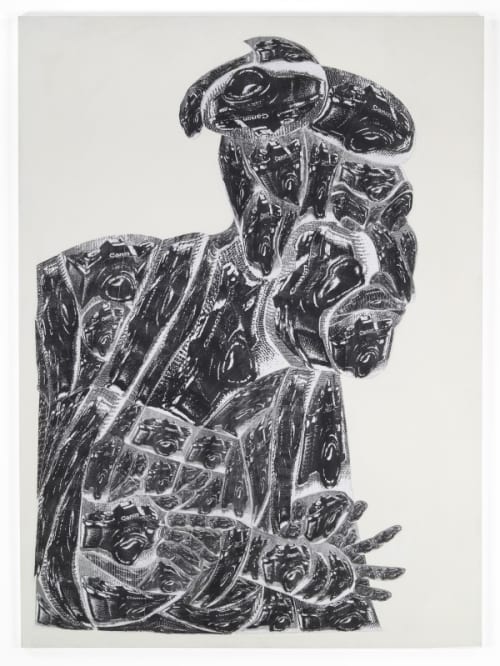
Thomas Baylre exclusively used analog methods of image manipulation for the first decades of his career. In the late 1980s, his student Stefan Mück created a program for the Atari Mega ST 4. It was one of the first commercially available personal computers with advanced graphics editing software capabilities. Mück’s program allowed the artist to digitize his methods and create works like “Canon Meets Sharaku” (1989).
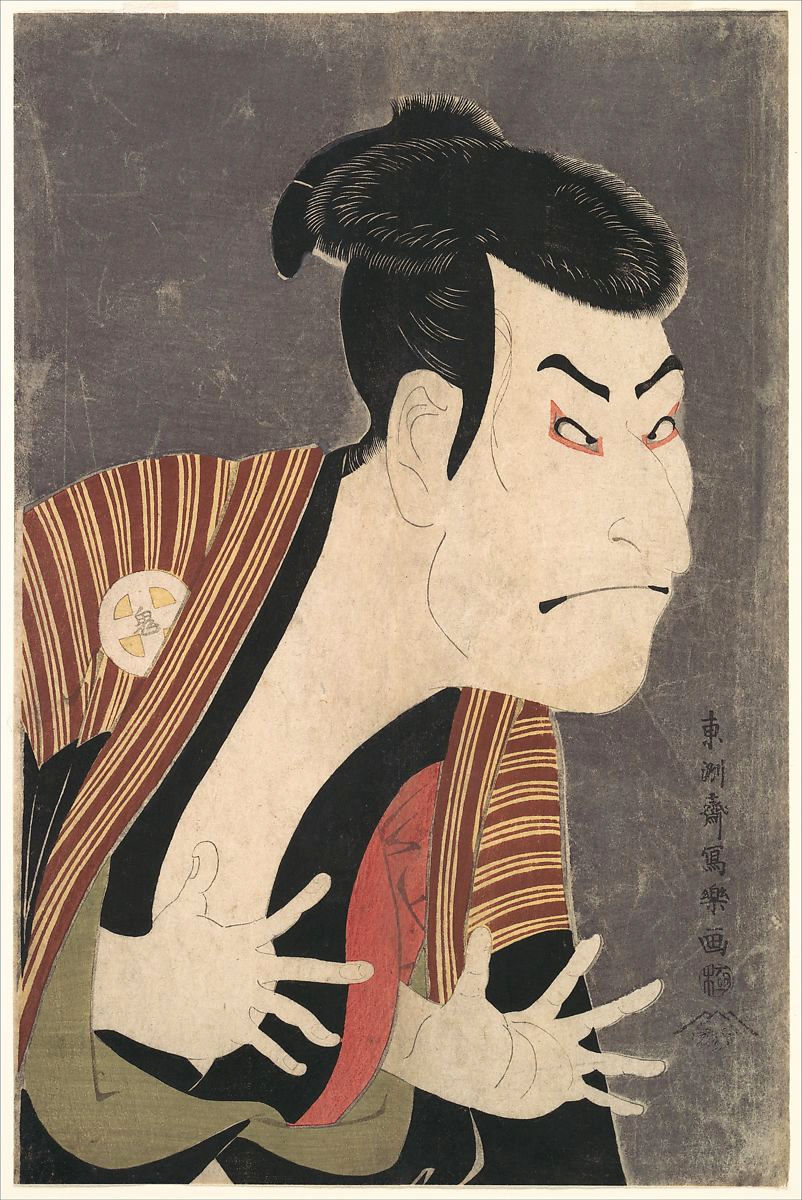
Tōshūsai Sharaku was one of the greatest ukiyo-e artists of all time. He was mysterious as he was prolific. He created 144 unique prints in only 10 months, which means he worked at the superhuman pace of publishing a new print about every two days. His true identity has never been discovered. It is speculated that Sharaku was an actor named Saitō Jūrōbei, an art collective, or even that it was a nom de plume of Katsushika Hokusai, the creator of “The Great Wave off Kanagawa” (1831). Regardless of his true identity, Sharaku specialized in yakusha-e, which are prints of Kabuki actors. This print shows the actor Otani Oniji III in the role of “Servant Edobei.” His crossed eyes and outstretched fingers are a traditional pose to show intense emotion. In the Edo Period from 1601 to 1868, these prints served as headshots for actors. This makes Bayrle’s use of a Canon camera very apropos. One can also read this work as a snapshot of the faceless Sharaku.
3
Thomas Bayrle
“Himmelfahrt [Ascension I]”, (2019)
Thomas Bayrle has become very interested in the Catholic Marian doctrine in recent years. All Christian denominations believe that Jesus Christ physically ascended into heaven after his death. According to Catholic dogma, his mother also ascended to heaven in this manner. Her Assumption is not written in the Bible, rather it first appears about four hundred years later in early Christian apocryphal texts. In addition to these texts, Mary’s Assumption has been the subject of countless artworks. Though the exact work of reference for Bayrle’s Ascension series and the figure’s gender remain undefined, it could very well be inspired by Guido Reni’s “The Assumption of the Blessed Virgin Mary”, which is on permanent display at the Städel Museum. Guido Reni’s “Assumption of the Virgin” bathes Mary and an orchestra of music-playing angels in a sumptuous, shimmering light. The angel under her foot and the cherubs at her sides seem to be physically exerting themselves, practically dragging her to heaven. Reni was one of the most important figures of Italian Baroque painting. He was a mere 23 years old when he painted this work.
In Bayrle’s Work, the figure is constituted of his superform motif “Rising Woman, Falling Man”. It shows a woman in a blue dress with her legs in a V-shape and an upside-down man to her left in the same position wearing a red shirt and gray pants. In the center of the figure, one motif is inscribed with “heaven” (Ger. Himmel) and an arrow pointing upward, next to the woman. There is a downward arrow and “hell” (Ger. Hölle) next to the man. The Virgin Mary is almost always shown wearing a blue overgarment, which represents purity and her role as the Queen of Heaven. Bayrle’s interest in Mary’s could be seen as a feminist project to both address her erasure in the Bible and assert her importance as the mother of Jesus Christ and progenitor of Christianity.


4
Thomas Bayrle
“Layout Philip Johnson” (1999)
In 1999, Bayrle created a series of ten black-and-white posters featuring sections of The New York Times and titled the series “Layout Philip Johnson”. Philip Johnson is regarded as one of the most influential U.S. American architects of the 20th century and one of the founders of postmodern architecture. He was greatly inspired by the works of architect Ludwig Mies van der Rohe – who fled Germany from Nazi persecution – and together they designed the iconic Seagram Building in Midtown Manhattan. One of Johnson’s most eye-catching designs is the Lipstick Building from 1986, which is also located in Midtown. Recently, Johnson’s well-documented praise of Adolf Hitler and alignment with white-supremacist and antisemitic ideology in the 1930s during his time as a journalist have caused debate about his legacy. He expressed regret for these views in 1993, but it was unclear if he regretted his hate speech or merely regretted having it published. In 2005, the New York Times published an obituary for Johnson in which they praised his contributions to architectural history but also highlighted his transgressions. Artists and institutions have since been calling for his name to be removed from certain titles and structures.
Bayrle’s inclusion of the New York Times could be interpreted as a rather scathing critique of Johnson. The publication was purchased and rebranded in 1896 by Adolph Ochs – who was the son of German Jewish immigrants – and has been published by his descendants ever since and is one of the most popular, award-winning newspapers in the world. Considering how Johnson used his journalistic voice to spread antisemitism and essentially rode the aesthetic and contractual coattails of exiled van der Rohe, it seems fitting to spread the news that his ugly past is still haunting him.


5
Thomas Bayrle
“Ballerina” (1972)
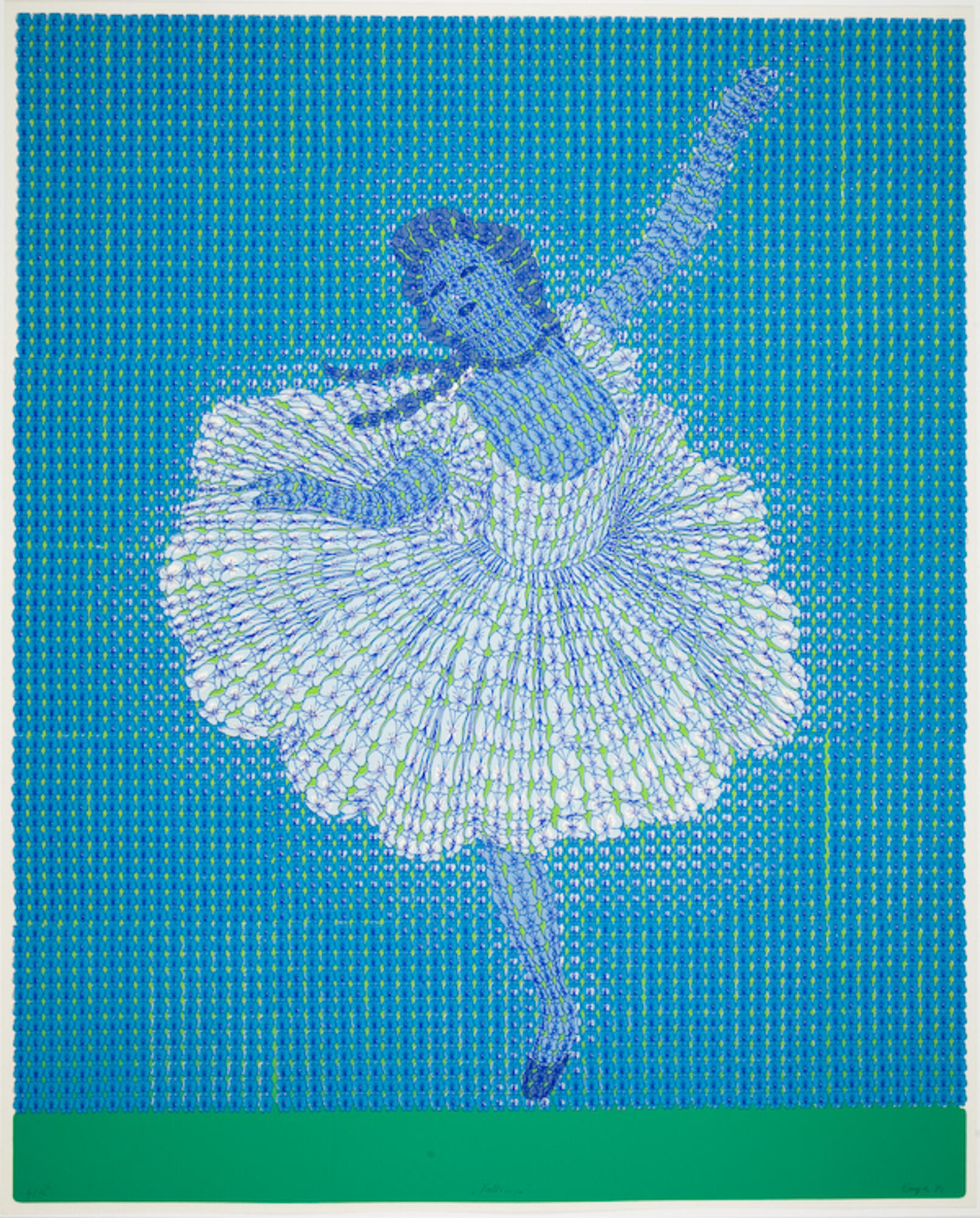
Delicate pansies in shades of blue form Bayrle’s “Ballerina”. Fans of the ballet will instantly recognize her as the “star” of Edgar Degas’ “L’étoile” (1876–1877). Degas was one of the founders of Impressionism and is known for his accurate portrayal of the glamorous high points and seedy underbelly of 19th-century Parisian performance arts.
The dancer’s delicately outstretched arms, fluttering ribbon, and bent knee suggest that she has just landed an impressive leap. Her rosy cheeks hint at her physical exertion, but her triumphant expression shows satisfaction in her performance. Between the gaslights hissing at her feet and the limelight blazing from the rafters, she sees only light. For this brief, glorious moment, the world falls away. She is the center of her own universe. However, trouble is never far away for a star. Her patron menaces her from the wings. The black ribbon around her neck transforms into a noose. Eight-year-old girls from poor families could experience a bit of upward mobility as a student of the Paris Opera Ballet School. At fourteen, they could enter the company and earn poverty wages. Rich patrons would sponsor their favorite dancers, but their financial support often came with sexual abuse. Pansies as the superform motif could be a reference to this dark reality. In 19th-century Western Europe, floriography (“the language of flowers”) was immensely popular. Pansies were associated with forbidden love. The ballerina cannot fully escape her patron, but in Bayrle’s world, she shares the stage with no one.

.jpg)
6
Thomas Bayrle
“Hl. Matthäus trifft Engel” (2015)
Thomas Bayrle’s “Hl. Matthäus trifft Engel” takes its form from Caravaggio’s painting “Inspiration of Saint Matthew” (Ital. San Matteo e angelo) from 1602. He was one of the pioneers of Italian Baroque painting. Caravaggio was known for his signature use of tenebrism – a high-contrast lighting technique of strongly lighting figures in very dark spaces, which creates a dramatic and emotional effect. In Christianity, Matthew is the author of the first chapter of the New Testament and is known as one of the “Four Evangelists”.
Caravaggio’s painting depicts a non-canonical moment of divine intervention as an angel visits Matthew and inspires him to write about the life and times of Jesus Christ. Matthew was apparently literally struck by inspiration and ran so quickly to his desk that he knocked the stool out and off the canvas, as evidenced by the trompe l’oeil – the optical illusion that a painting is three-dimensional. Christians believe that Matthew wrote his text about 60 years after Jesus’s death to document the testimonies of the last eyewitnesses of his life before they died. For Caravaggio, physical bibles were political objects. In the 16th and 17th centuries, many new editions of the bible were printed and distributed. Bible burnings swept across Europe as politicians and clergymen attempted to censor versions they deemed too radical. Their effort was in vain. With estimates as high as 7 billion copies, the Bible remains the most printed book in history. Bayrle’s superform version of Caravaggio’s work is made up of hands holding iPhones. They all display the original painting on the screens, creating a mise en abyme – an image within an image. Bayrle’s evocation of the origins of Christian scripture and censorship combined with commentary on the ubiquity of smartphones, brings up questions of authenticity and reproductions. Because “the internet is forever,” smartphones and social media have made complete censorship almost impossible. Democratized access to information is arguably positive, but one must ask themselves if the information is accurate. Is a digital copy a faithful, adequate version of the original? What is lost and what is gained in the process of reproducing text and images?


7
Thomas Bayrle
“Madonna Mercedes” (1989)
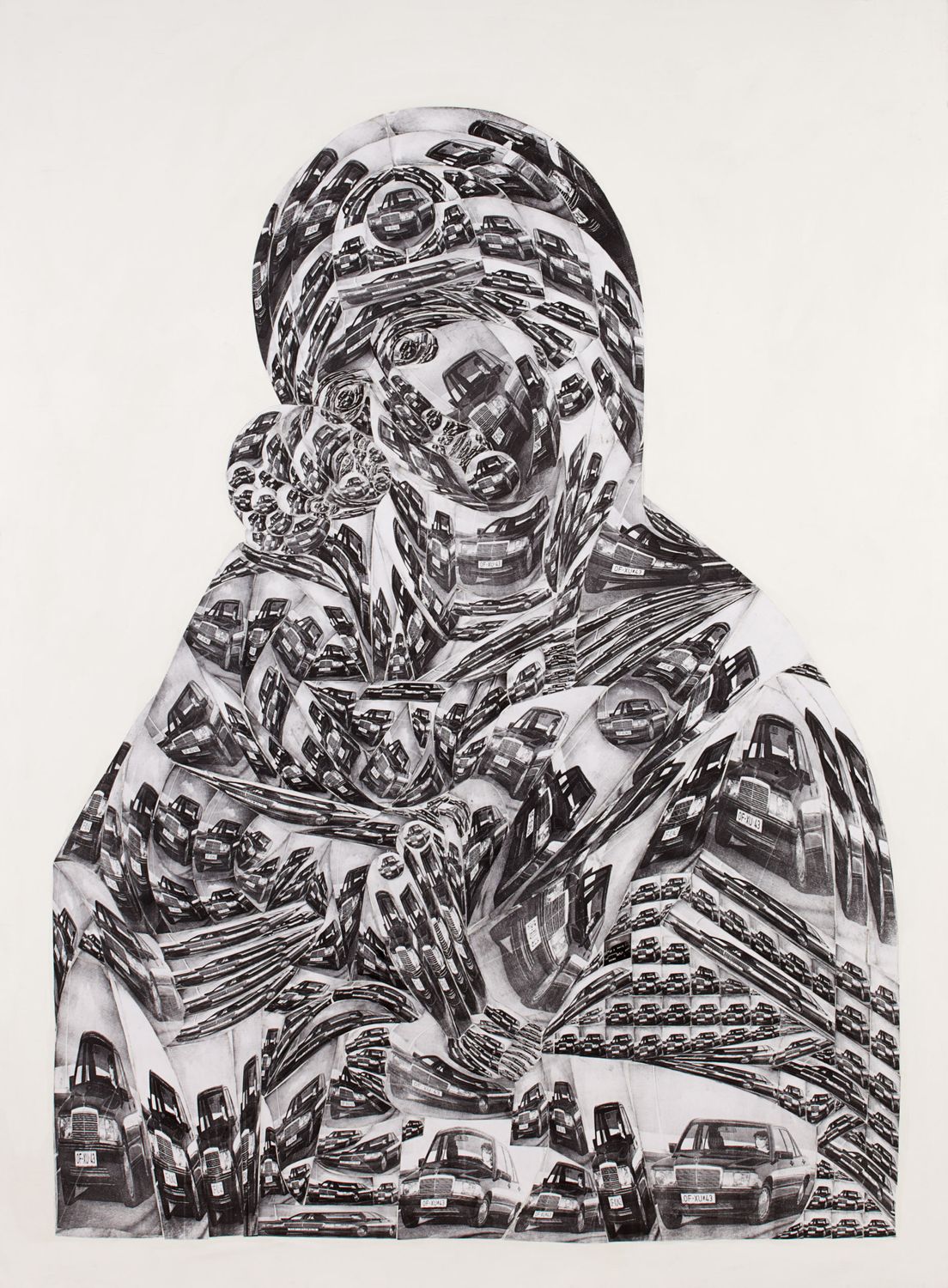
Bayrle’s “Madonna Mercedes” (1989) is modeled after the Byzantine Eleusa “The Virgin of Vladimir”. The Eleusa, or “Virgin of Tenderness”, is a genre of iconography in which the Virgin Mary holds the Christ Child to her cheek. Her forlorn expression represents her future sadness over her son’s death. The reverse side of the icon shows the Hetoimasia (Greek: “preparation”), an empty throne that represents Jesus Christ’s prophesied return to Earth. “The Virgin of Vladimir” is one of the most important icons and holy objects in the Orthodox Catholic Church. The artist is unknown, but according to legend, it was painted by another coauthor of the bible, Luke the Evangelist. It was made in the early 12th century in Constantinople, passed through Kyiv, and came to the Russian city of Vladimir in 1155. Finally, it ended up in Moscow in the 14th century, where it has been ever since. It supposedly protected the city from multiple attacks in the 14th and 15th centuries and performed other miracles over the centuries.
Bayrle created “Madonna Mercedes” by using his signature technique of photographing stretched sheets of latex. For this work, he went to a copy shop in downtown Frankfurt and rented a photocopier by the hour. With the help of assistants, he stretched latex sheets printed with a Mercedes-Benz car directly on the platen glass of the copier. Then, he cut up the photocopies and collaged them into the forms of the icon. Uncut pages from these printing sessions show the eight thumbprints of Bayrle and his assistants as they held the latex. Whereas “The Virgin of Vladimir” is a religious icon, Carl Benz is an icon of German ingenuity and engineering, having patented the world’s first automobile. In the cult of the car, the Benz is king. The collision between the ancient world, religion, technology, and consumerism in Bayrle’s “Madonna” raises questions of faith and to whom (or what) people pray.

8
Thomas Bayrle
“Roll Over Smartfon I” (2019)
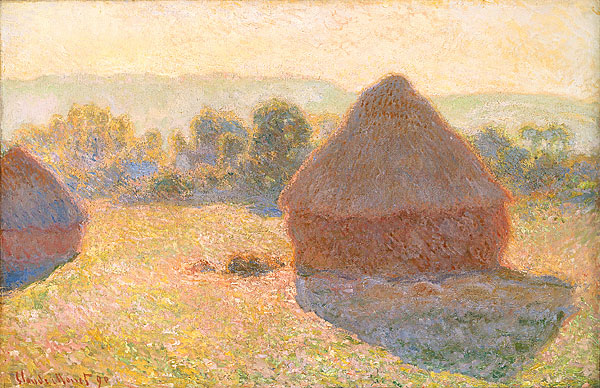
In addition to his famous waterlilies, impressionist trailblazer Claude Monet painted a series of “Les Meules à Giverny” (Fr. “The Stacks at Giverny”). Between 1890 and 1891, he created twenty-five paintings of humble haystacks on the farms near his home. He was fascinated by how light changes over the day, in different seasons, and during different atmospheric phenomena. He tried to document his experience of time and his impression of changes rather than recreate frozen moments of realistic landscapes.
In 2019, tech-billionaire and co-founder of the SAP software company Hasso Plattner purchased one of the haystacks for a staggering $110,747,000 at auction. This made it the most valuable impressionist painting of all time. Thomas Bayrle created a series of haystack digital prints inspired by Monet’s series. Rows of smartphones replace the hay in “Roll Over Smartfon I” (2019). The title of the work is rather cheeky. It alludes to the Chuck Berry song “Roll Over Beethoven”. In the song, the “Father of Rock and Roll” tells Ludwig van Beethoven to roll over (in his grave) and tell Pyotr Ilyich Tchaikovsky that rock and roll is here to stay. It is one of the most covered rock songs, with over one hundred recordings, including bands like The Beatles, Electric Light Orchestra, The Rolling Stones, and even Iron Maiden. Bayrle’s work straddles the divide between a pessimistic reality and an optimistic utopia, with most of his works with smartphone superforms leaning toward pessimism. Rock and roll changed the world and democratized music in a largely positive way. Smartphone technology previously only existed in speculative science fiction media. They have had harmful influences, but they have also democratized access to information, art, and global communication. Smartphones alone will not herald the age of utopia, but perhaps they are bringing us a few steps closer.

_-_Google_Art_Project.jpg)
9
Thomas Bayrle
“Brancacci Chapel” (2020)
The Earth came as close to a standstill as a planet spinning at 1,674.7 km/h can in the year 2020. The Pandemic. It was the first mass mortality event of the 21st century. The pre-Pandemic world was fraught with problems, but in hindsight, it feels like a paradise lost. In response, Thomas Bayrle created “Brancacci Chapel” (2020) with superforms of people wearing medical masks. It is based on the 1425 fresco “The Expulsion from the Garden of Eden” (Ital.: “Cacciata dei progenitori dall’Eden”) in the Brancacci Chapel in Florence by Masaccio. He was only 26 years old when he died in 1428, but Masaccio is regarded as one of the most influential Italian Painters of the 15th century.
In the biblical “Book of Genesis,” the Expulsion is the moment the first humans, Adam and Eve, are cast out of the Garden of Eden for disobeying God and choosing to eat fruit from the Tree of Knowledge of Good and Evil. Adam’s idealized body is very anatomically accurate, and Eve holds her right hand across her breasts and shields her mons pubis with her left in a classical Venus Pudica (Greek: “modest Venus”) pose. Both figures are characteristic of the Renaissance impulse to emulate Greek sculptures and restore art from the perceived aesthetic decline of the Middle Ages. However, the fresco is unusually emotional for this time period. Adam buries his face in his hands out of shame. Eve throws her head back in agony. Her face is frozen in an endless, silent scream.


10
Thomas Bayrle
“Kim Kardashian XII”(2021)
Love her or hate her, you recognize her. Thomas Bayrle created a series of prints featuring media personality Kim Kardashian. He built her out of lipsticks, which refers to her influence in the global beauty and fashion industries, as well as the way she has commodified her life into consumable brands. Kardashian is posed like Dutch Golden Age painter Johannes Vermeer’s “Girl with a Pearl Earring” (Dutch: “Meisje met de parel”) from 1665. Often mistaken as a commissioned portrait, it is actually a tronie, which is a painting of a fictional person used to convey emotions or allegories. The girl’s fashionable, blue turban was painted with ultramarine made of pulverized lapis lazuli from Afghanistan. By weight, this pigment was several times more expensive than gold in 17th-century Europe. The girl’s massive, eyeball-sized pearl is an illusion. It is not actually a sphere, but rather two strokes of paint floating between her unpierced earlobe and shoulder. From the expensive paint to the strikingly large pearl, the girl represents an unattainable level of luxury. Kim Kardashian is the modern personification of this ideal. Through makeup, body modification, highly-edited images, and an on-call PR team, she built a career on illusions. Like the girl, she advertises an artificial, fantastical level of luxury that exists outside the bounds of nature.
Kardashian is a highly photographed fashion chameleon, but there is evidence that Bayrle used photos of her from the Metropolitan Museum of Art’s 2018 Costume Institute Gala with the theme “Heavenly Bodies: Fashion and the Catholic Imagination.” Her high ponytail and cascading hair are reminiscent of the girl’s turban, and her custom Versace gown echoes the gold of the girl’s garment. Kardashian did not just serve a look on this evening, but also international justice. She had herself photographed next to the 2,100-year-old main attraction of the temporary exhibition “Nedjemankh and His Gilded Coffin.” The MET had purchased the coffin the year prior for $4.1 million. Her post went viral and was seen by one of the looters who had originally stolen it in 2011. Upset that he did not receive payment, he contacted the Manhattan district attorney’s office. The ensuing investigation showed that a German gallerist had falsified documents and had it trafficked through West Asia, Hamburg, and Paris before being purchased by the MET. Many people were consequently arrested for their involvement. The coffin was successfully repatriated back to Egypt in 2019, and the MET issued a statement denying prior knowledge of the crimes.


:upscale()/2018/05/08/652/n/1922153/6470577c3c204fb6_GettyImages-955810176.jpg)