Of women who rule the world
08/19/2026
7 min reading time

In her art, Leonor Fini created a new social order, populated by sphinxes and militant heroines. And was inspired by numerous historical influences.
The Surrealists developed a new, liberated visual language
Born in Buenos Aires as a child of Italian and Slav parents and brought up in Trieste in the circle of James Joyce and Rainer Maria Rilke, Fini turned to numerous historical sources for inspiration as she mastered her own artistic style and iconography. In her work she took inspiration from a range of artists – from Hieronymus Bosch and the Italian Mannerist Agnolo Bronzino to Gustav Klimt, Egon Schiele and Giorgio de Chirico.
When she moved to Paris in 1931 in search of Surrealist art she happily found that she was better versed in the writings of Sigmund Freud, Franz Kafka and Friedrich Nietzsche than many others in that group of Surrealist artists. Merging various influences in her meticulous brush strokes, lavish palette and textures, with her interests in psychoanalysis, philosophy, mythology and sorcery, Fini’s focus on woman as a sensual and sexual creature – and often a cruel dominatrix or predator – led Surrealism in new directions.

Fini’s depictions of women steered Surrealism in a new direction
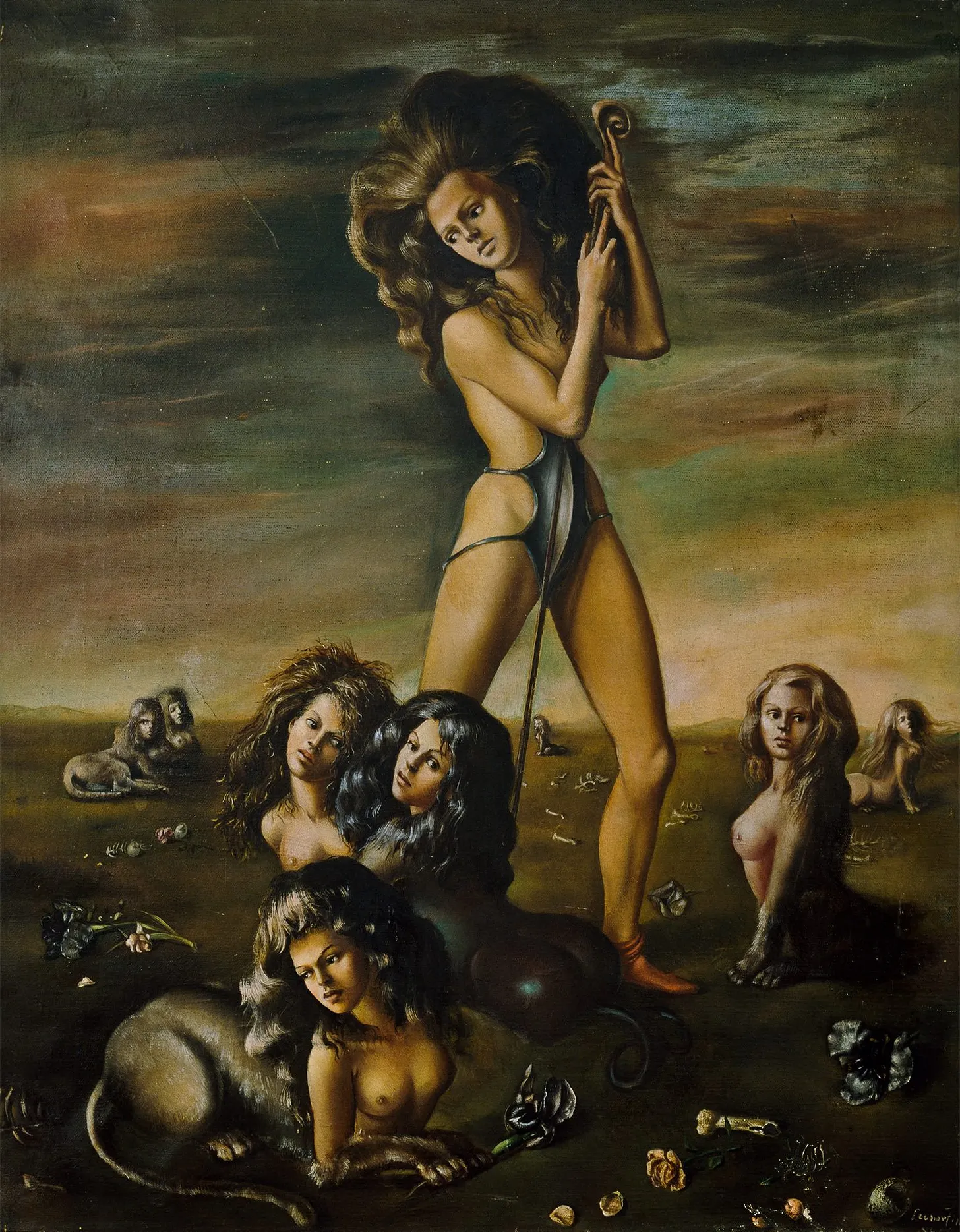
In Fini’s early work “The Curious One” (1936), painted for her first show at the Julien Levy Gallery in New York, an elderly male spies on a tall female in pre-Raphaelite dress holding a riding crop. The door ensures the scene hovers between dream and nightmare while the viewer is drawn into an erotic drama in which he/she is a voyeur. This dynamic would come to dominate all of Fini’s canvases as she obsessively returned to the femme-fatale image, portraying women – including herself and female friends – with leonine hair, fin-du-siècle costumes, and a bold Medusa-like stare. In “The Shepherdess of the Sphinxes” (1941) the same female type is presented amongst a harem of sphinxes in an equally desolate landscape, but she is now wearing a skimpy metal armour which serves to lead the eye of the viewer to her sex and to the phallic staff she wields.
Male surrealists often turned to Greek mythology, notably the tale of Oedipus, so it is not surprising that Fini repeatedly portrayed the sphinx from the very same mythological tale. However, she differed from many of her male peers in staging the sphinx as all-powerful and the Oedipal male as a plaything for her fancy, as seen in some of her most famous works, notably “Chthonian Deity Watching over the Sleep of a Young Man” (1946) and “Le Bout du Monde” (1949) where skulls surround the sphinx.
In these paintings, Fini effectively reverses the traditional roles of man and woman as she stages the female as a heroic figure and the male as a beautiful, passive nude (modelled after her lover, the Italian Count Sforzino Sforza). Fini explained that the nude male was often asleep in her paintings as “men allow the duties of work, social life and war to anaesthetize them to the life of the spirit”. The sphinx dominates the wartime-paintings of Fini, allowing her to reverse traditional gender roles as well as to critique a society in which men are expected to be aggressive, and women to be passive.
The sphinx – half woman half lioness – symbolized the fusion of masculine and feminine characteristics, the animus and the anima, and the vision of a less aggressive social order. Indeed, it was a creature Fini perceived as the perfect fusion of both sexes, and she identified with the sphinx as she felt she was “hybrid,” too.