I Put a Spell on You. Jessica Hundley on the occult and Leonor Fini
10/29/2026
8 min reading time


Witches, sphinxes, and mysterious creatures: Leonor Fini created a universe brimming with magic, mythology, and the occult. We speak to Jessica Hundley, editor of TASCHEN’s Library of Esoterica, the artist’s fascination with the supernatural, her radical vision of female autonomy, and the enduring power of esoteric imagery.
Jessica, there is a strong interest in witchcraft today. For instance, so called “etsy witches” are having a hype, more and more people are hiring them to do spells. Why do you think that is? And why does the figure of the witch still speak to us?
Jessica HUndley
I think we’re experiencing a profound cultural desire for re-enchantment. For centuries, modernity has separated science from spirit, humanity from nature, reason from intuition. We’ve gained extraordinary knowledge, but perhaps lost something essential: a sense of participation in a living, mysterious universe. The resurgence of interest in witchcraft reflects a longing to recover that relationship.
The witch is compelling because she represents autonomy, imagination, and an intimate knowledge of the natural world. Historically, accusations of witchcraft often enforced religious and social conformity, particularly among women. Today, the witch has been reclaimed as an archetype of resistance: someone who trusts her instincts and refuses prescribed roles.
Of course, there’s a difference between the commercialization of witchcraft and its deeper traditions. A ritual, at its most meaningful, is an act of focused attention. And creativity itself can be a kind of magic: we take an intangible image or feeling and give it material form. In an age of technological advancement, ecological crisis, and spiritual uncertainty, we also need wonder, connection, and meaning.
Someone who was already interested in witches a long time ago and features them heavily in her work, is Leonor Fini. What does Fini change about the traditional image of the witch in her art, for example in “Le Sabbat ressuscité” (1957)?
Jessica Hundley
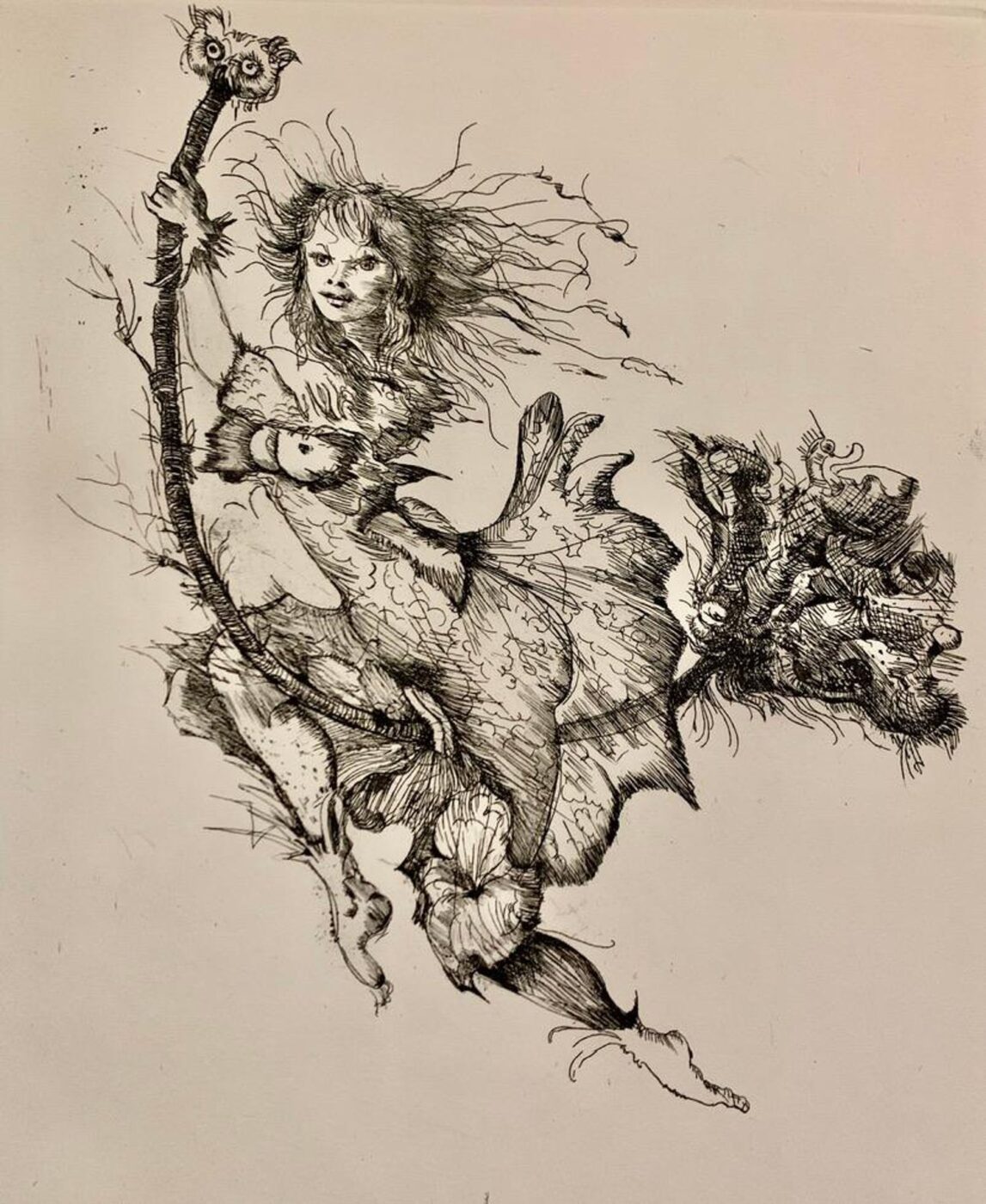
What I love about Fini’s witches is that they seem completely uninterested in behaving themselves. For “Le Sabbat ressuscité,” created with Jacques Audiberti, she made 35 etchings of unruly, erotic, humorous, sometimes absurd figures whose bodies shift between human, animal, and supernatural forms.
The familiar image of the witches’ Sabbath emerged in 15th-century Europe, when authorities combined beliefs about harmful magic and nocturnal gatherings with the idea of a conspiracy devoted to the Devil. The Sabbath described in witch-trial records was largely a construction of persecuting authorities. Artists helped establish its imagery: Hans Baldung Grien’s “The Witches” (1510) combined eroticism, danger, and supernatural disorder, while Goya later depicted terrifying nocturnal gatherings.
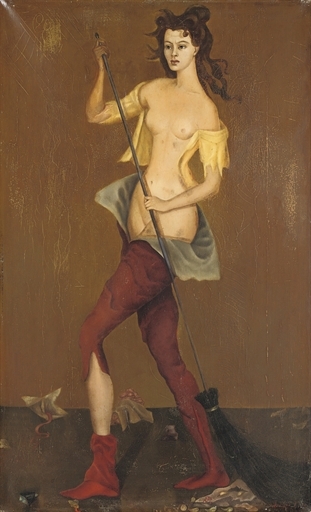
Historically, the witch embodied misogynistic fears of female sexuality, independence, aging, and knowledge. Fini overturns this image. Her witches are neither tragic victims nor monsters. They’re self-possessed, pleasure-seeking, playful, and unconcerned with social approval. Humor becomes part of their freedom.
Her interest continued into her contribution to the inaugural issue of the feminist journal Sorcières in 1976, although she resisted restrictive labels herself. She doesn’t simply rehabilitate the witch; she lets her remain strange and unknowable. Her power lies in refusing to be domesticated.


You’re an expert on all things esoteric art. Where would you place Leonor Fini within the history of esoteric art, and what makes her interpretation of mythology, magic, and the occult so distinctive?
Jessica Hundley
Leonor Fini is one of the artists I return to again and again. We’ve included her work in every volume of TASCHEN’s Library of Esoterica, whether exploring Tarot, astrology, witchcraft, or the spirit world. She was fundamentally interested in transformation, sexuality, nature, death, and the relationship between visible and invisible worlds.
I see her as one of the great mythmakers of the 20th century, drawing on Renaissance allegory, Romanticism, Symbolism, and Surrealism. Yet she resisted belonging to any movement. Although she exhibited alongside the Surrealists, she rejected André Breton’s authority and the limitations of their predominantly masculine worldview. She wanted to construct her own mythology.
Her universe of sphinxes, priestesses, witches, and androgynous beings draws on esoteric symbols without adhering to any doctrine. Where women in Surrealism often appeared as muses or objects of desire, Fini made them the authors and guardians of their own mysteries. She didn’t simply paint fantastic worlds; through costume, theatricality, and self-invention, she inhabited them. She transformed inherited symbols into a personal language of freedom.
Fini drew on classical mythology, Renaissance painting, German Romanticism, and Baroque theatricality, but never reproduced these traditions faithfully. Mythology, magic, and the occult offered her interconnected symbolic languages, which she transformed into a visual world uniquely her own.


As you just mentioned, Finis world consists not only of witches but of a plethora of mythical beings as well as cats. What connects these protagonists in your opinion, especially her sphinxes?
Jessica Hundley
The connecting principle is resistance to boundaries: human and animal, masculine and feminine, mortal and divine. In mythology, hybrids often guard thresholds between worlds. Fini was fascinated by beings that couldn’t be easily classified.
The sphinx is especially revealing. In ancient Egypt it often represented protection and royal authority; in Greek myth, the female sphinx poses a riddle and is defeated by Oedipus. Fini reverses that narrative. Her sphinxes aren’t obstacles for a male hero to overcome. They possess their own authority, sensuality, and mystery. I think Fini recognized herself in the sphinx: a figure free to exist between identities, without needing to be explained.
Cats were also beloved companions in her life, not merely artistic motifs. Historically associated with divinity, witchcraft, intuition, and independence, they embody an intelligence resistant to human control. Her cats and hybrids suggest that the boundaries between ourselves and the rest of the living world may be more permeable than we imagine.
As you can see, metamorphosis is central to this world: figures hover between genders, between human and animal, and between life and death. In Ovid’s Metamorphoses, beings continually exchange forms; alchemy offers another parallel, where transmutation of matter can suggest a transformation of consciousness. For me, this is the liberating promise of her work: identity isn’t fixed, and art allows us to imagine another body, another identity, another world.
If you could choose one work by Leonor Fini, that we should pay special attention to, which would it be, and why?
Jessica Hundley
I would choose “The Guardian of the Black Egg (La Gardienne à l’œuf noir)” from 1955. It’s one of her most mysterious paintings, expressing the creative and transformative power of the feminine. The egg is an ancient symbol of creation, regeneration, and potential. In alchemy, it can represent the vessel in which transformation unfolds; blackness recalls the nigredo, a stage of dissolution before renewal.
What moves me is that the egg remains intact. It contains something unknown, still becoming, and the woman protects that possibility rather than forcing it into being. Artists, too, are guardians of ideas that haven’t yet found their form. In contrast to the spectacular imagery of magic, this painting suggests something quieter: the act of tending to possibility.

Lastly: You yourself live in Los Angeles, a city where esotericism, spirituality, and art have always been closely intertwined. Do you still encounter Fini’s influence there today? And what other marks has she left on the worlds of contemporary art, fashion, and film?
Jessica Hundley
Fini’s legacy feels increasingly relevant because questions of fluid identity, gender and power, and the imaginative possibilities of the body are central to contemporary culture. I see affinities with Kiki Smith’s mythology and animal imagery, Wangechi Mutu’s hybrid figures, and Penny Slinger’s explorations of sexuality and ritual, though not necessarily direct lines of influence.
In fashion, the connection is tangible. Fini collaborated with Elsa Schiaparelli on the Shocking perfume bottle, and her elaborate masks and costumes turned identity into theater. Maria Grazia Chiuri drew directly on her for Dior’s Spring 2018 haute couture collection. In film, Anna Biller’s “The Love Witch” shares a fascination with fantasy, eroticism, and feminist critique.
Los Angeles, with its history of image-making and spiritual experimentation, offers a compelling parallel. Marjorie Cameron explored the divine feminine, ritual, and supernatural identity; Penny Slinger connects Surrealism, mysticism, and feminism. Like Fini, these artists use images to imagine alternative realities. Fini reminds us that we’re not merely inheritors of mythology. We’re also its creators.