

How can Art challenge AI’s Right-Wing Turn?
Disguise, 2022, 5 Objekte, je 30 × 30 × 1cm, UV-Druck
auf Leinen, Bambus, Stickgarn
08/13/2026
5 min reading time

With the rise of AI, reactionary gender roles and racist worldviews blend seamlessly with soothing images of country living, infusing the internet aesthetic of cottagecore with political meaning. What role can art play in interrupting, exposing, and critically examining AI’s contribution to the spread of right-wing ideology?

Disguise, 2022, 5 Objekte, je 30 × 30 × 1cm, UV-Druck
auf Leinen, Bambus, Stickgarn

Disguise, 2022, 5 Objekte, je 30 × 30 × 1cm, UV-Druck
auf Leinen, Bambus, Stickgarn
Public sphere and counter-public
The global circulation of mass-produced and AI-generated content on social media—described as “slopaganda” or “AI flooding”—has become an increasingly important tool in the hands of authoritarian actors. Holding on to the political concept of counter-publics as alternative sites to the hegemonic production of public opinion, the workshop explored whether art can still generate spaces of critical reflection within a media landscape fundamentally reshaped by digital platforms and artificial intelligence.
Among the workshop’s many contributions, a panel discussion featuring Anne Simone Kiesel, Katrin Köppert and Antonio Somaini tackled this question from different perspectives. Working as both a scholar and a curator, Somaini argued for a new form of visual literacy capable of understanding what he calls “infrastructural images”: highly mediated images that compress the infrastructural layers from which they emerge.
Köppert, who also delivered a compelling keynote on the fragmentation of the digital public sphere drawing on Black radical thought such as Sylvia Wynter, Zakiyyah Iman Jackson, Rizvana Bradley a.o., emphasized the central role of infrastructure at a moment when processes of fascization intersect with neoliberal individualism. Rather than merely reproducing the conditions of its own production, she argued, art should create alternative infrastructures through its very making.
Art historian and critic Anne Simone Kiesel pointed to Mimi Ọnụọha’s “Ground Truths” (2025) as an example of this challenge. The 16-minute docu-fiction film follows Ọnụọha’s attempt to develop a machine-learning model capable of identifying plausible locations of mass graves of Black people across Texas. As the artist writes on her website, the work asks: “What happens when the tools we trust to reveal truth are built from the very systems that produce erasure?” In doing so, “Ground Truths” exposes the tensions that arise when AI is used to produce alternative forms of knowledge.
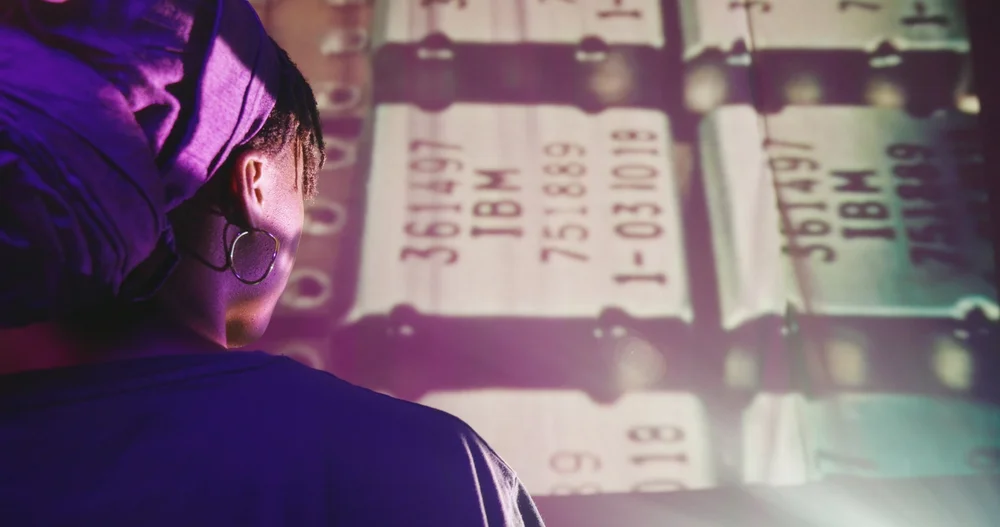
“What happens when the tools we trust to reveal truth are built from the very systems that produce erasure?”
Mimi Ọnụọha
A matter of infrastructural (in)dependance
Ọnụọha’s work resonates with “Reinscribing the Dondorf” (2025) by Ania Szczepańska, currently on view in the exhibition “The World Through AI” at SCHIRN. Invited to engage with the layered and politically contested history of the Dondorf Druckerei, the artist and scholar created a film that reflects on the possibilities and limitations of AI when working with archival materials to write contemporary history.
As Dominik Laute and I have argued elsewhere, memes often conceal and perpetuate particular perspectives by presenting them as universally valid. The rise of “meme wars” is therefore hardly surprising. As the workshop’s title suggests, artistic practices that aim at countering such dynamics of digital fascization cannot do so on the surface of content generation. Rather, they need to steer the attention to the infrastructural dimensions that dominate today’s AI-driven image production, while reorienting the affective reactions that such unsettling look into the depths of technological abstraction may imply.

