

5 Artworks that have written Pride history
06/09/2026
8 min reading time

June is upon us with vacation time, sunshine, and the World Cup all in the air, not to forget: It’s Pride Month, so high time to focus on artworks and artists who express their solidarity with the LGBTQIA+ community and have championed its rights!
Pride Month has been celebrated in the queer community since 1970. It was launched to commemorate the Stonewall riots that started in June 1969 outside the Stonewall Inn, a gay bar on Christopher Street, New York. They marked a major milestone in the history of the US lesbian and gay movement and later that in the rest of the western world. Alongside festive parades, a leisurely mood, many rainbow flags flying (not to mention dubious special “Pride” collections by Nike, Adidas, et al), Pride Month above all has a socio-political dimension: It has its origins in the relentless struggles against discrimination of the LGBTQIA+ community.
In light of the global rollback as regards the rights of queer people, the strident positioning and memory of the early days of the Pride movement are now more important than ever. Members of the art and cultural world are often allies in the battle against oppression and express solidarity with the community, so it is no surprise that various artists and artworks have decisively helped shape Pride history. Here are five prime examples.
1
Keith Haring
“Ignorance = Fear / Silence = Death” (1989)
You cannot talk about the early days of the US lesbian and gay movement without mentioning the comic-like, sexless, colorful outline figures created by US artist Keith Haring. The 1970s and 1980s were not only shaped by rebellions against social injustice, but also by the outbreak of the HIV/AIDS epidemic. Owing to stigmatization, discrimination, and marginalization, it affected above all gay men and members of the LGBTQIA+ community – and Haring also fell victim to it, dying at the tender age of only 31. Even before the outbreak of the epidemic, with his art, which is reminiscent of the aesthetics of graffito and Pop Art, he addressed socio-political issues. Haring above all championed the rights of the queer community.
As an activist he was later strongly involved in information campaigns on HIV/AIDS. Among others, with its political message his iconic 1989 poster entitled “Ignorance = Fear / Silence = Death” that was displayed that same year on the sides of New York busses went down in art history. He originally created it for the relatively new ACT UP (AIDS Coalition to Unleash Power) movement. Haring also produced T-shirts with the protest messages he had designed. To this day, his unmistakable figures are to be seen on articles of clothing, flags, and posters. They symbolize solidarity with the LGBTQIA+ community and the struggle for equal rights.

2
Andy Warhol
“Ladies and Gentlemen (Marsha P. Johnson)” (1975)
Pop Artist Andy Warhol was an important figure in the LGBTQIA+ movement. Not only did his New York studio, The Factory, have a strong influence in the 1960s as a meeting place for queer people. The subject matter of his art, which was already popular at the time, always helped create a more visible profile for queer lived realities among the mainstream.
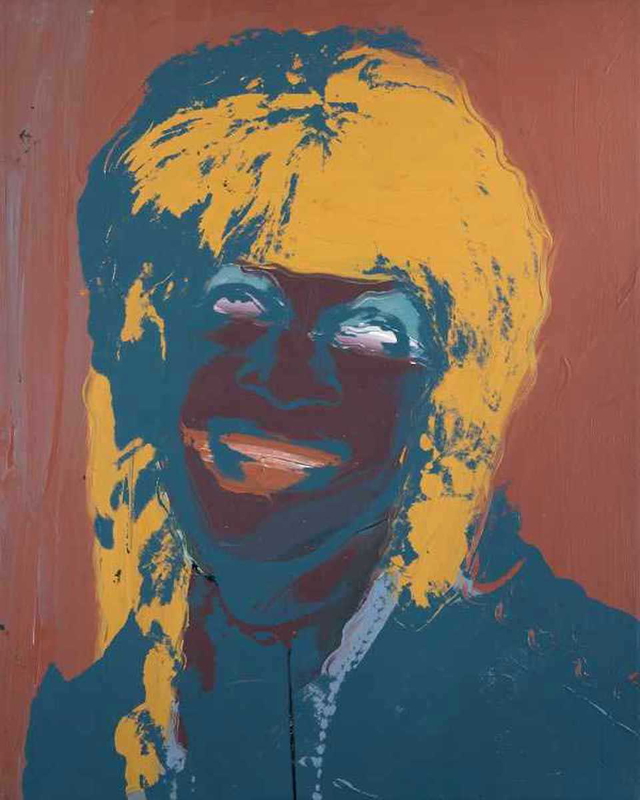
A great example of this is his 1975 10-part silkscreen series entitled “Ladies and Gentlemen,” which consists of portraits of Black and Latinx drag queens and transwomen, who were among the intersectional discriminated minority within the LGBTQIA+ community. One of the persons Warhol portrayed is activist Marsha P. Johnson: He enlarged a Polaroid photo of her and silkscreened it onto canvas. Marsha P. Johnson, who was nicknamed the “Saint of Christopher Street,” was a central figure in the above-mentioned Stonewall riots. According to eyewitnesses, she was one of the first persons who loudly protested against police violence and discrimination during a raid on the bar. The riots that ensued lasted for several days and culminated in widescale solidarity within the community that served to bind it more closely together. As a consequence of the Stonewall riots, countless groups of activists arose as well as social and political initiatives that fought together for the rights of the LGBTQIA+ community. Together with the “Gay Liberation Front” Marsha P. Johnson organized protest marches that laid the foundations for today’s CSD demonstrations in and around Pride Month.
3
L.J. Roberts
“Stormé at Stonewall” (2019)
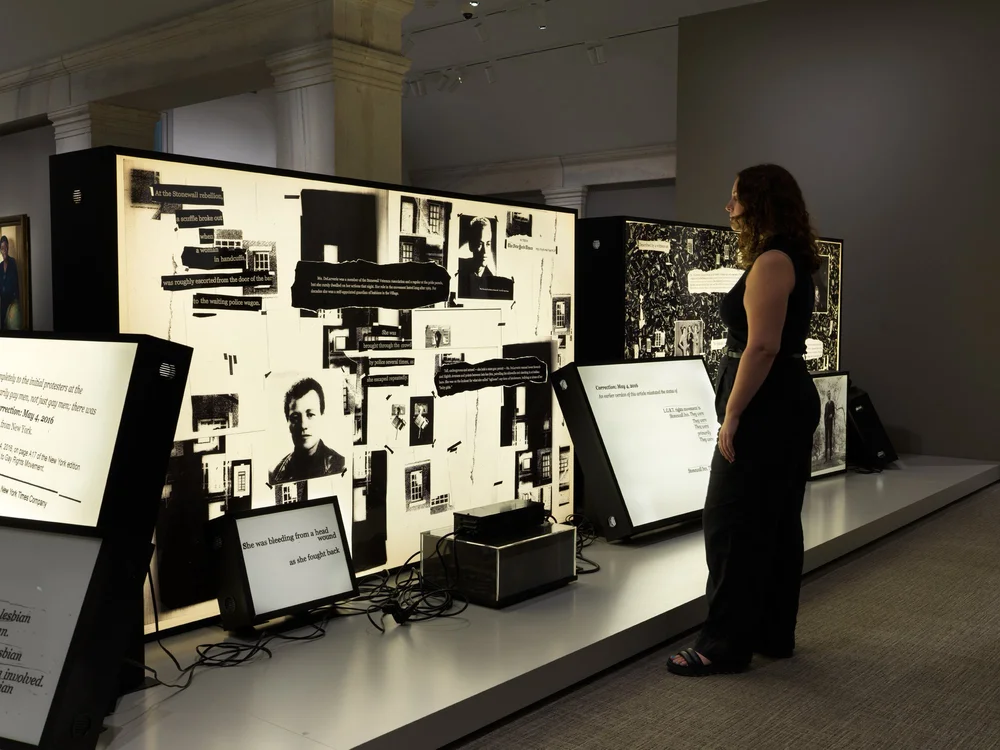
Unlike their historical colleagues, L.J. Roberts is a contemporary US artist. Roberts is well-known in particular for their large-format textile installations and is forever committed to giving the forgotten or repressed histories of the LGBTQIA+ community greater visibility. The main theme in Roberts’ art is the representation of queer culture in the past and present. Their 2019 installation “Stormé at Stonewall” forges a direct link to the Stonewall riots and, in a manner similar to Warhol in his silkscreen series, foregrounds central and yet marginalized persons. The installation resembles an archive and consists of lightboxes that contain collages of newspaper articles and photographs. Roberts focuses specifically on the representation of Stormé DeLarverie at various stages of her life: Like Marsha P. Johnson DeLarverie played a key role in the rebellion at the Stonewall Inn. As an activist and artist, DeLarverie above all championed the rights of lesbian women and was the only drag king to perform alongside 25 drag queens in a popular drag show that toured coast to coast. DeLarverie is a pioneer for queer women with the wish to perform as a drag king – and yet her history has been forgotten. With their lightbox installation and its commemoration of its beginnings, Roberts supports the still under-represented drag king scene, just as they advocate lesbian visibility and the strong and influential role of lesbian women in the Pride movement since 1970.
4
Catherine Opie
“Dyke” (1993)
Queer women are less present, and not only as central figures in the Pride movement, but also in the fine arts, where an artistic exploration of lesbian identities and lived realities receives less attention than discussion of gay identity.
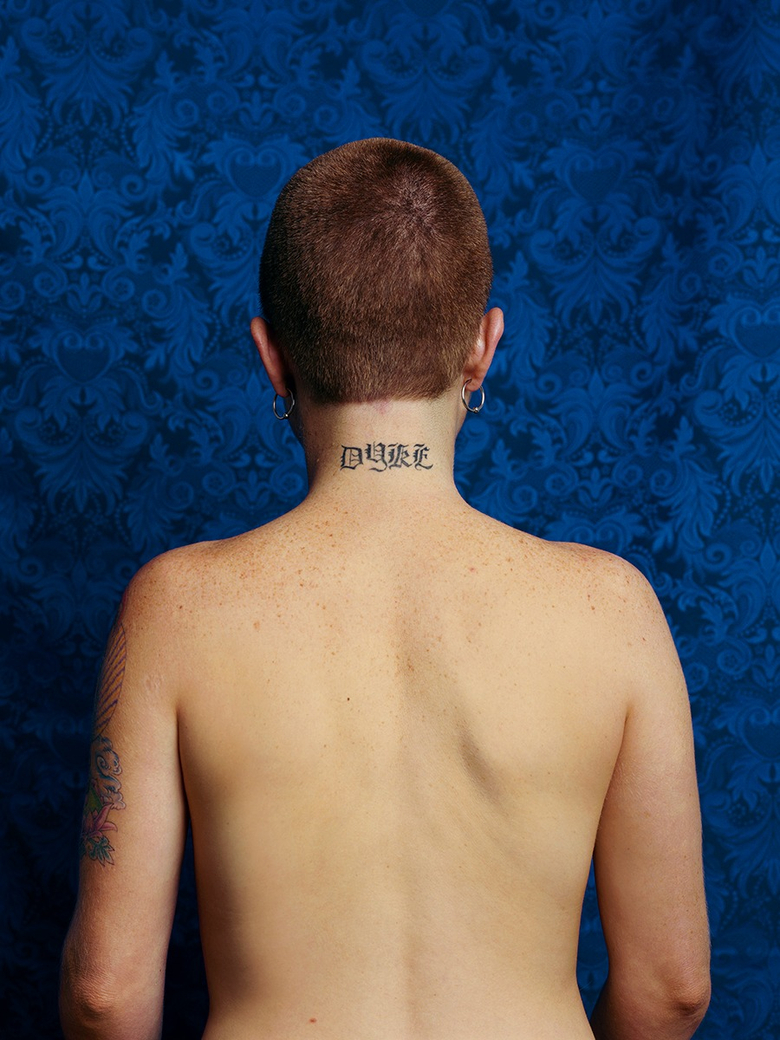
Catherine Opie’s 1993 photograph “Dyke” is treated as an absolute icon within the lesbian community. Once a derogatory term for lesbian women, “dyke” today has become a self-designation in the sense of self-empowerment. Since the early 1990s, Opie’s oeuvre has also consisted of photographs that represent queer subculture and highlight themes such as queer parenthood. Moreover, as a member of the LGBTQIA+ community she portrayed herself in different moments of her own life. Just as Haring’s figures still get printed on T-shirts and serve as signs of identity and solidarity, the claim “Dyke” in Gothic script is used in the lesbian community: on T-shirts, caps, or even, as in Opie’s photograph, as a tattoo.
Incidentally, the Fridericianum in Kassel is hosting Catherine Opie’s first institutional solo show in Germany – it runs until July 19!
5
Daniel Quasar
“Progress Pride Flag” (2018)
In 2018, Daniel Quasar designed the “Progress Pride Flag”. Unlike the classic rainbow flag, which Gilbert Baker created in 1978, with its horizontal stripes in the colors red, orange, yellow, green, blue, and violet, the “Progress Pride Flag” contains far more shapes and colors. Quasar’s intention was to design a more inclusive flag that emphasized the intersectionality of the contemporary LGBTQIA+ community. The arrow with the chevrons that Quasar integrates into the customary rainbow flag and which points to the right is meant to symbolize the forward movement. Moreover, the colors chosen emphasize the ongoing lack of visibility for marginalized queer identities within the LGBTQIA+ community: The colors white, light pink, and light blue stand for the trans-community; the brown stripes represent Black, indigenous peoples and other People of Color and their intersectional struggles, while the color black stands for those living with AIDS, those no longer living, and the stigma surrounding them. Since the “Progressive Pride Flag” first went into production thanks to crowdfunding, its presence has spread rapidly. Quasar’s work replaces the now traditional rainbow flag and symbolizes openness and the constant advances in the Pride movement.
