
Strike a Pose! On the performativity of musical cultures
03/05/2026
10 min reading time

In their films, Bárbara Wagner and Benjamin de Burca explore musical cultures and the communities that drive them. Brega and Swingueira, spoken-word poetry and straight-edge hardcore punk. In the process, the duo repeatedly highlights elements that for all the orchestrated nature appear somehow intimate.
Lorem Ipsum
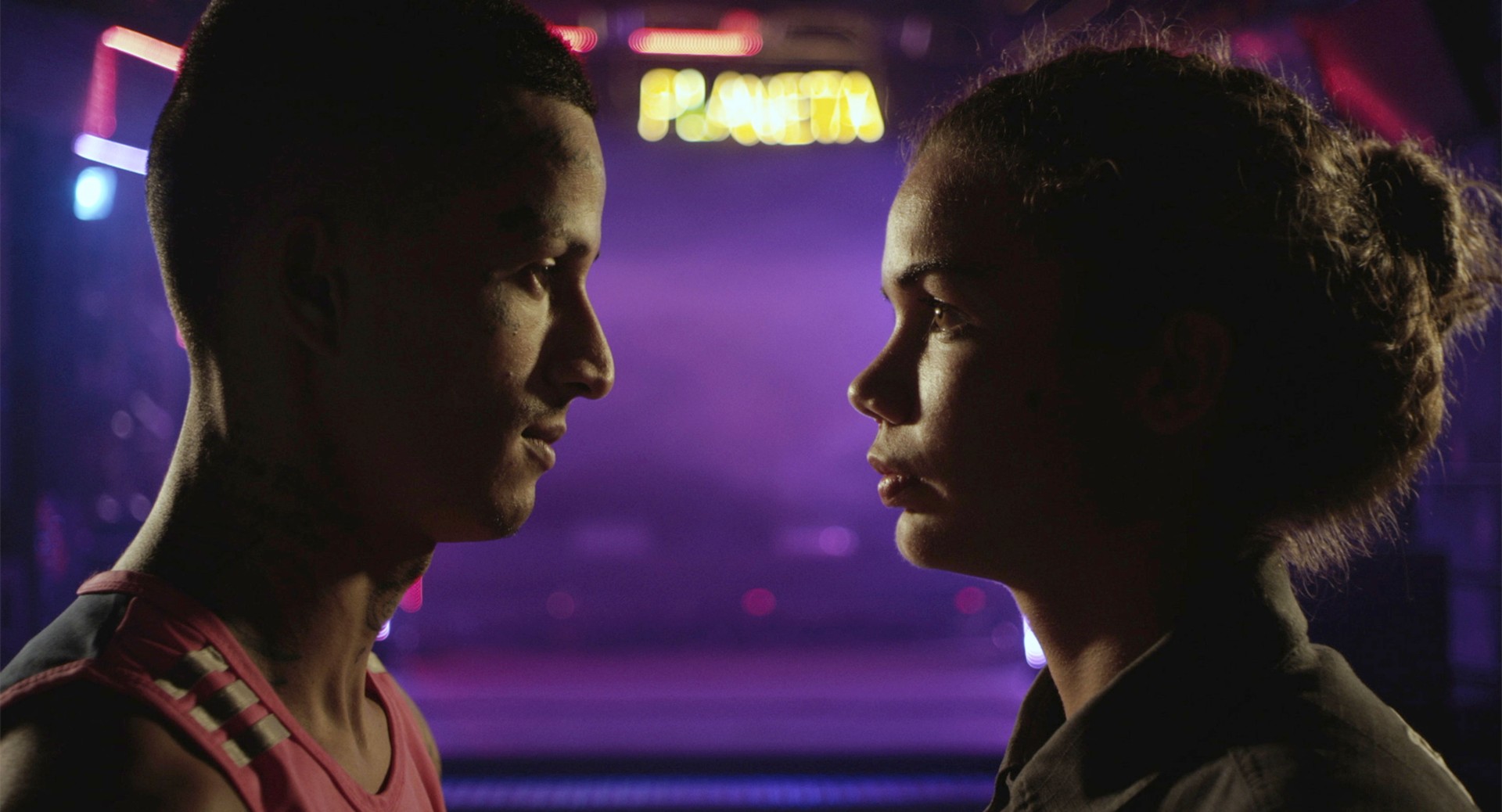
Two faces in profile, almost forehead to forehead. The background: violet neon light, blurred, perhaps a stage, perhaps a club. The two gaze at each other, without moving, concentrated. It could be a moment before a kiss. Or before a fight. I think involuntarily of Piero della Francesca’s famous diptych of the two aristocrats in strict profile, looking at each other and yet past each other. But here in this opening scene of “Estás vendo coisas / You Are Seeing Things” (2016) on Brazil’s Brega scene, everything is filled with tension, with neon, with sound, with the sense of a competition. In their films, Bárbara Wagner and Benjamin de Burca explore aspects of musical cultures and the communities that drive them. Brega and Swingueira, spoken-word poetry and straight-edge hardcore punk. They repeatedly highlight moments that for all the orchestration appear seemingly intimate. Their films lead viewers through images that catch the eye: A young man who is combing his beard and using his Smartphone as his mirror; but he is only semi-immersed in this small gesture of self-styling, as he gazes over at the camera that is filming him, at us who are viewing what is recorded. Or a person who is shaving their hair and holding a round makeup mirror in front of them like a shield or an eye; green neon light clads the skin, transforms the face into something unreal, almost extraterrestrial. These are scenes where you ask yourself if it is a private moment or a performance that is being documented, whether someone is preparing themselves or whether the act of preparing is itself the performance.
In their influential essay on “Girls and Subcultures” (1977) cultural studies experts Angela McRobbie and Jenny Garber pointed out that there was a blind spot in research on subculture: It concentrated on public, male-dominated spaces (the street, the club, the concert) and therefore overlooked the private spaces where subcultural identity likewise formed. McRobbie and Garber coined the term “bedroom culture” to describe it – the bedroom as the space where young women explore and practice their membership of a scene, in front of a mirror, doing their make-up or when listening to music with other girls. Wagner and de Burca are interested in precisely such moments. They position their camera where visibility is created before it becomes public: when combing in front of your mobile phone display, when carefully examining your face in the make-up mirror. But unlike McRobbie and Garber the focus here is not on a protected space to which the persons have withdrawn. The line dividing private preparation and public presence has become permeable, or perhaps it never really existed. The act of preparation is itself a performance in front of the mirror or the camera. Wagner and de Burca are not staging the look behind the scenes here, a look that as far as possible remains undiscovered when penetrating the private space to reveal something there. If they reveal anything at all, then it is that even the most intimate moments can have the character of a performance.



On the performativity of subcultures
It is anything but simple to name the people who move in subcultural scenes; indeed, there is a real linguistic dilemma. In academic texts the talk is often of “members”. But “members”? That sounds like a membership list for a club, along with membership fees and period of notice. “Participants”? sounds like a weekend seminar. “Supporters”? A bit like a sect, no? “Protagonists”? Overly heroic.
But this dilemma itself says a lot. There is no really accurate word for someone who belongs to a scene without having joined it, who is present without having been accepted, and at some point, is no longer there without having quit. Subcultural membership doesn’t function like membership. It is performative. You are part of it by taking part.
Wagner and de Burca take this seriously. In their films they speak of the people as “artists”. They show artists with their own practices, their own methodology, their own voice. Not representatives of a scene, not examples of a style, but actors who are working away at their own visibility.
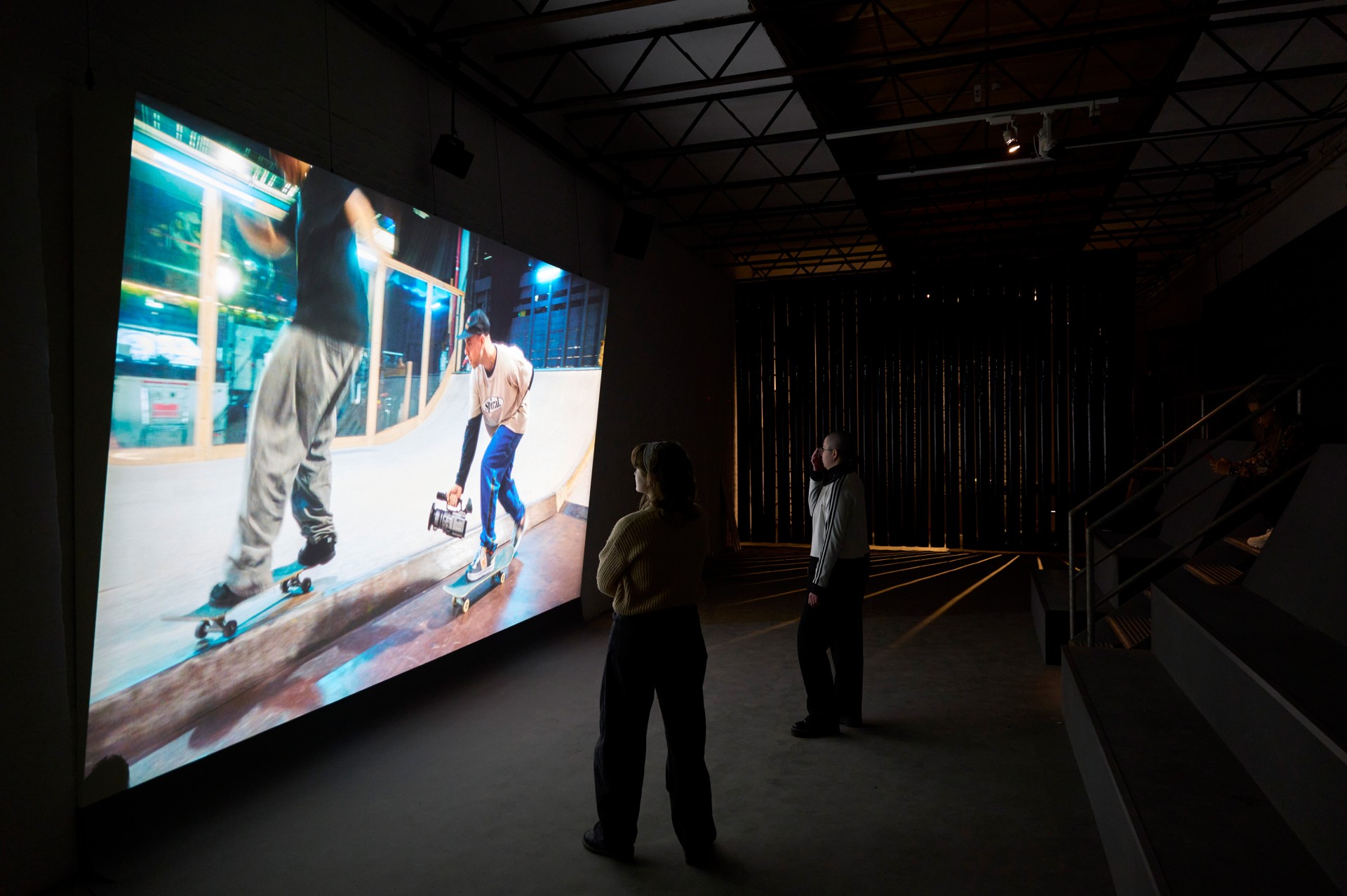
In “RISE” (2018), a film about spoken-word poets in Brazil, there is a scene in which you see a performer who performs his text and in the same image you see the cameraman filming him and other people who are watching and for their part being filmed. The camera is not invisible, it is part of the social situation. There is not outside from where you could take a neutral position as every glance is already a positioning. This runs like a red thread through all the duo’s works. We repeatedly see screens, monitors, CCTV images. We are both backstage and at the same time in the auditorium, present in the recording and in its processing.
In the book “Club Cultures: Music, Media, and Subcultural Capital” (1995) Sarah Thornton described how subcultures are always from the outset conveyed by media. In the early days primarily by flyers, fanzines, album covers, and now also through the Internet and social media. The notion of an “authentic” scene that is only subsequently discovered and then distorted by the media is, she says, a myth. Media are from the outset part of what makes a scene a scene. Wagner and de Burca seem to share this view. Their films do not show subculture despite the camera but through it. The camera is not some intruder, is not located outside but intervenes. It units spaces and times, bonds stars and fans, the individuals, in one group, produces proximity and distance at one and the same time. Here, performing in front of the camera does not simply mean “presenting yourself”. It means behaving in light of an apparatus that produces, increases, and distributes visibility. The elaborate staging of light fits into this. For Wagner and de Burca lighting is not just decoration or the mood-maker, but something that distributes visibility. Anyone standing in the cone of light is present. Anyone who is in the shadows is still waiting.
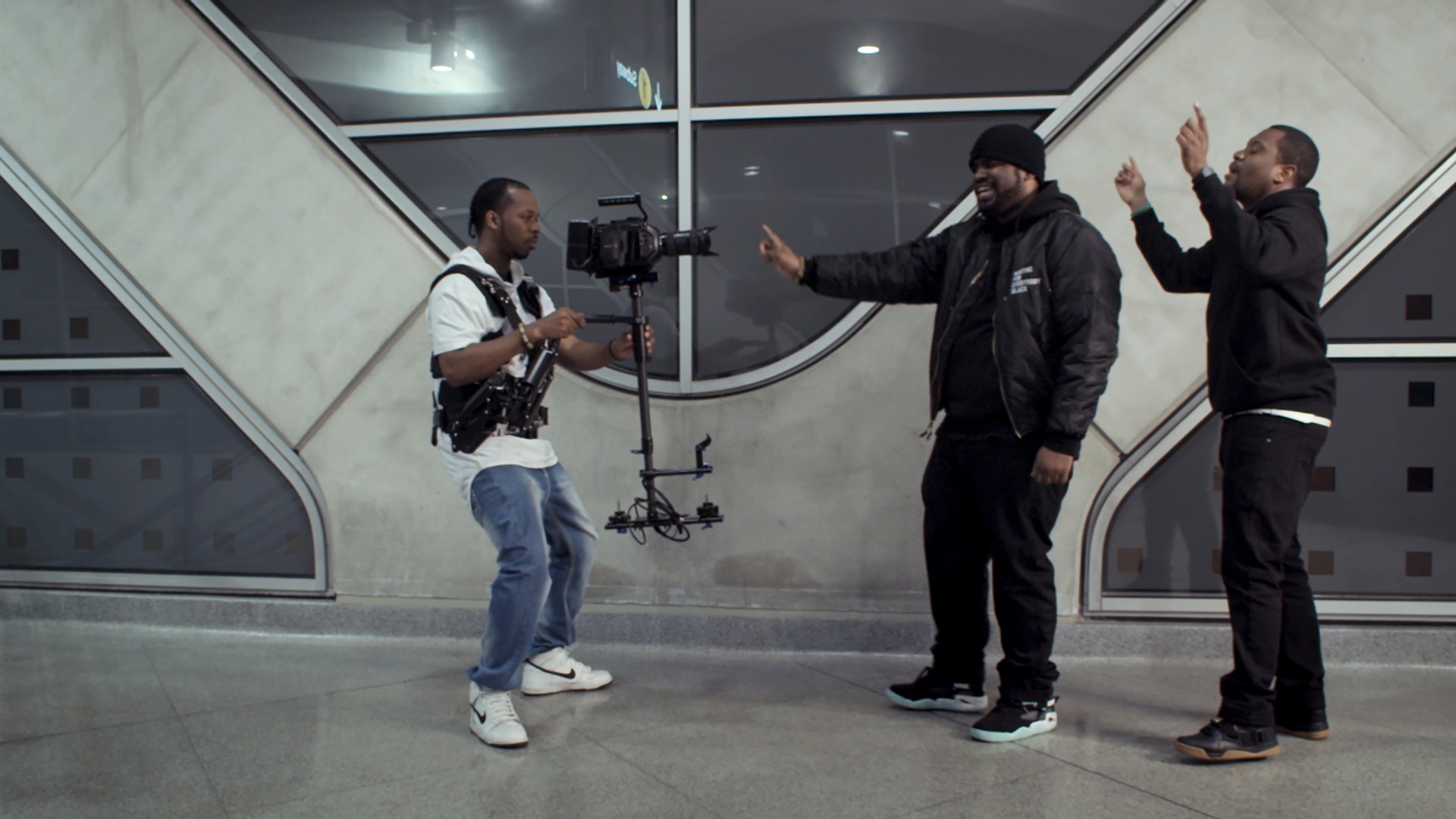
“Every glance is already a positioning. We are both backstage and at the same time in the auditorium, present in the recording and in its processing.”
Film as subcultural practice
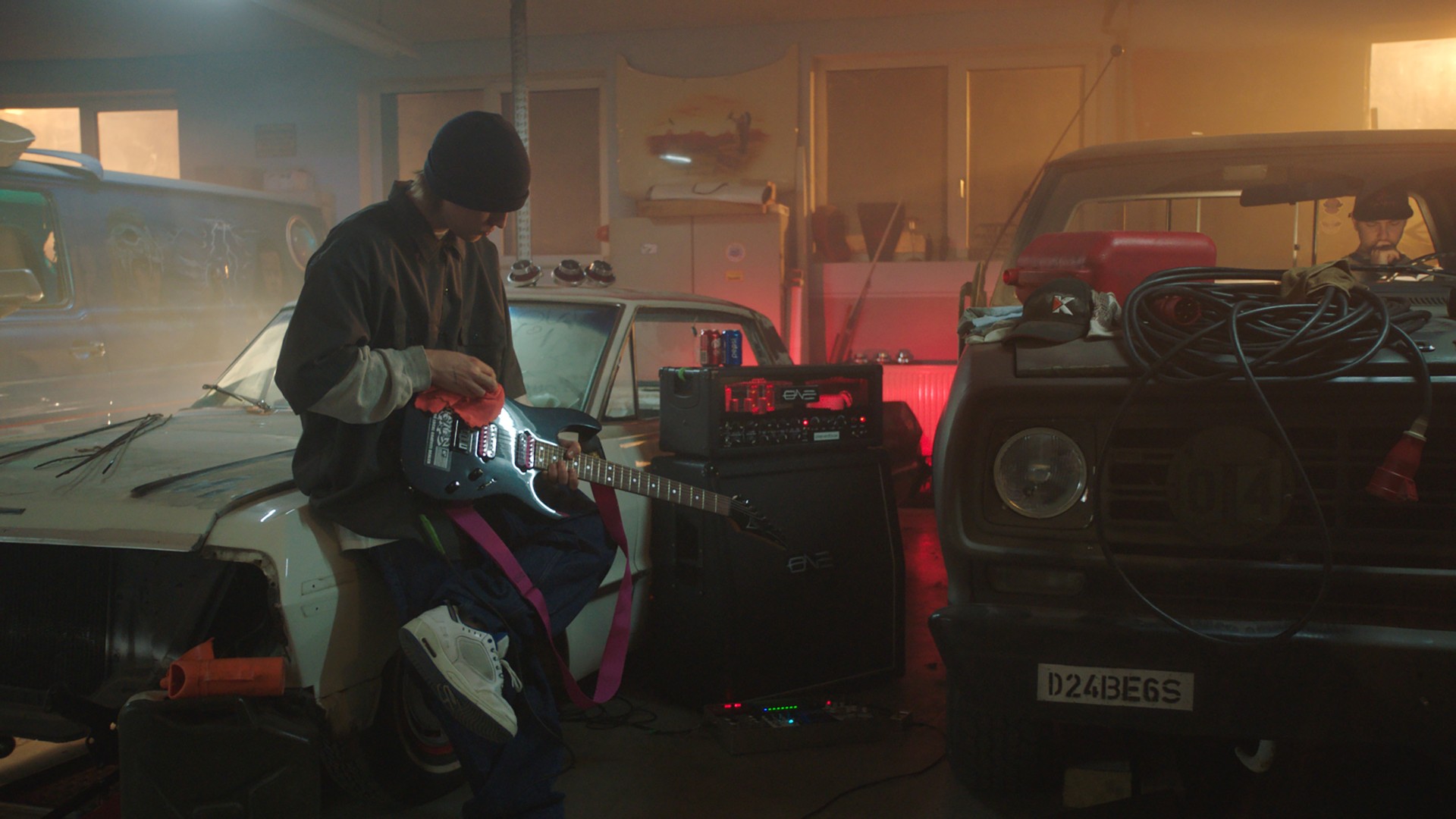
In “Future of Yesterday” (2026) Wagner and de Burca’s camera immerses itself in the German Straight-Edge Hardcore scene, a subculture that views sobriety as a logical gesture of resistance to capitalism. The camera leads us viewers through different images and settings. An old videotape recording shows a shellac album on a deck; the pickup arm going into action; a red label that rotates. Then, shot in high-gloss, a woman at a self-made silkscreening machine. A garage with toxic-green walls in which a man in a flannel shirt is lovingly polishing the hood of a van with an orange-and-black paintjob. The man and his vehicle are simply there, in matter-of-fact everydayness. The camera pans on and captures a workshop that is choc-a-bloc with stuff and in which someone with their back to the camera plays guitar, surrounded by car tires, a silver helmet, and stacked crates.
These settings and objects are not so many nostalgic props. They are, as Dick Hebdige poignantly said in “Subcultures. The Meaning of Style” (1979) “mundane objects”. Everyday items that through their use become symbols. In this context, Hebdige drew on Max Ernst and the concept of bricolage: the combination of things that do not really belong together in order to generate new meanings. Subcultural bricolage, Hebdige suggests, works like the author of a Surrealist collage: It brings together seemingly incompatible realities and thus generates exciting connections. But bricolage describes not just a subcultural practice; it also describes Wagner and de Burca’s filmic method. They do not just document a scene, they collage documentary and staged, authentic and surreal elements; speed blends with slow motion, sharp focus with blurs. Their films are in Hebdige’s sense themselves subcultural practice. This shows all too clearly that Wagner and de Burca do not introduce these images into the scene from the outside but work closely with the actors of the subculture they document.
The title of their film “You Are Seeing Things” is ambiguous. “You see things” can mean you are hallucinating, imagining things. And it can also mean: You are at long last seeing something that was always there. Both readings apply. These films do not dissolve the documentary into fiction; they take it to the point of absurdity by exposing its conditions. The real appears not beyond all staging but in it. Not despite the pose but through it.
The establishing shot, two profiles in neon, minimum distance between them, maximum tension, thus sets the agenda. It leaves open what is otherwise overly hastily decided. Is this confrontation or intimacy? Authenticity or performance? Document or staging? Wagner and de Burca do not force us to decide. They present subculture not as a spectacle for an external audience, but as ongoing work on your own visibility. It is work that Wagner and de Burca accompany with respect and aesthetic precision without appropriating it.