

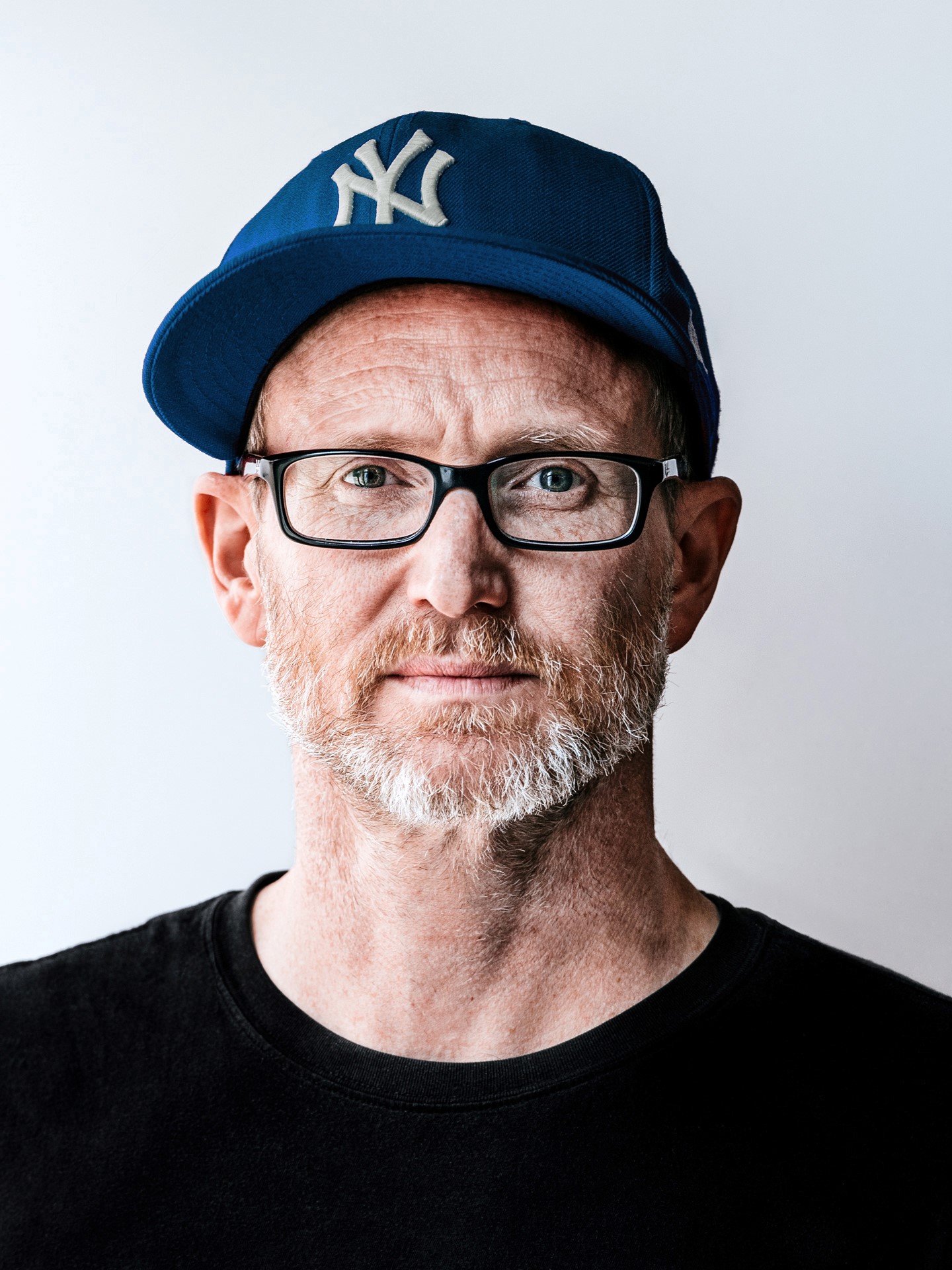
With his art, Frankfurt-based artist Mike Bouchet questions social processes and uses a wide variety of media such as sculpture, installation, paintings and film. He addresses questions of urbanity and consumption in his works. Before Mike Bouchet came to Germany, the California native studied with Richard Jackson at the University of California in Los Angeles, which developed into a long friendship.
Richard and you have been friends for a long time, sharing certain conceptions and practices, but also coming from the same area of California. How have you experienced his attitude towards art?
Richard is a surprisingly open person. He is also a very practical, hands-on, and hard-working person, with an extremely developed sense of humor. In regards to how he lives and makes art, he has never followed any traditional stereotypes of how an artist should behave or live. Richard has preserved his healthy and perceptive skepticism towards inflated perceptions of art and artists. Considering how many artists Richard is close with, I’d say he is an authority on this. For him, the meaning of making art, is connected to how you choose to spend your time. In this regard, it’s very political and open.
He has always produced art that requires a lot of personal and intense labor. Although I don’t feel he assigns any kind of heightened emotional meaning to the making of art, he does assign a personal value to it. I think a good example are his installations. Richard constructs every element - the walls, the floor, all the objects, the electrical and mechanical work - by himself. He makes a myriad of creative and playful decisions in this process – many are invisible. He then uses these various mechanical and impersonal materials to paint them - ultimately it‘s out of his control, and the effect cannot be planned in advance. Perhaps it‘s a bit like a baker spending months and years making the perfect wedding cake, and then putting it in a washing machine to see how it looks like afterwards. It’s all slightly absurd, and at the same time I take this is a highly political gesture.
For him, the meaning of making art, is connected to how you choose to spend your time.
You studied at University of California (UCLA) at the time Richard Jackson was part of the faculty. How did you experience him there?
The art department was a small enclave in a large university, which in itself has an intense academic environment. At that particular moment, the faculty had a number of professors with a performance and conceptual art background. The art market didn’t really exist the way we think of it now. I‘d say the school had a relatively purist and conceptual environment. The art department was not academic, but it was rigorous. Richard taught in a number of departments – sculpture, conceptual art, and also painting. His own practice covered different media. He became extremely popular among the students, as he was enthusiastic and provided them with very practical knowledge about what to expect after school.
He opened up his classes to more and more people, and refused to give grades. Everyone got an “A” no matter what they did. Sometimes 50 students visited his class. He brought a positive energy to the school, which was motivating and inspired discussions among the students. I would say his general message was: “Make art that you like; make art because you want to make it for yourself. If you want to keep working as an artist, don’t sit around waiting to get invited, don’t put yourself in a pathetic position and go figure out a way to make a living so you can keep making art. Having a job isn’t some problem or uncool. Having a job and making art after work is fine. Simply hoping for someone to discover you is putting yourself in a compromised position.”
He was also irreverent towards a traditionally hierarchical art world, with professor as master-student dynamics. There was a rich exchange between teachers and students, everything was leading to discussions, often till late at night. It was very sincere. It also became kind of a community. Some other professors reacted strongly against that, and ultimately pushed him out.


What would you say when reflecting on his work as extended painting?
What he proposes, in a more general sense, is that there are thousand ways of making a painting, and more importantly in looking at paint. Also, that the canvas itself is, to a large degree, a very conservative format. There are very conservative structures for what we experience in art contexts, and he pokes fun at them. Richard inherently positions himself against this, against the rarified object and art making, as a rarified activity. He takes the mysticism out of it in various ways. Why is spilled paint on a canvas considered as something so important, but spilled paint on a floor, or on a piece of furniture such a problem? It‘s a question of intentionality, or in his case- perceived intentionality. And if it‘s simply this, then there is a whole world to work with. So, on one level, painting is expanded, yes, and of course there is a lot more going on. He also defines a much wider context within how the painting is experienced. The whole environment he builds for these combinations of objects, actions, gestures, materials, colors, and so on, cannot be divorced from the space he builds for them. They are tableaus in many cases, and they form an entity, but they don’t function in the traditional sense of tableaus.
How do you relate your practice to the one of Richard Jackson?
Some people keep telling me that there is some sort of a West Coast attitude… I suppose there is, and there is a particular type of counter-cultural attitude that has a longer history in California. And I think there is a certain attitude that Richard also has, but rather in relation to the art world or to art history. West Coast art from more or less the last 60 years implies lot of social criticism. However, in the case of Richard, I would say that he is not reactionary, but he is a reactionist. What you don’t agree with, can be a springboard for your work, but it’s not its ultimate value. It’s also a way of making art that is not constrained by art theory or academic theory; you can apply it, but you do not necessarily need it. I suppose it’s often about an individual observation and reflection on human life in a particular time and place.