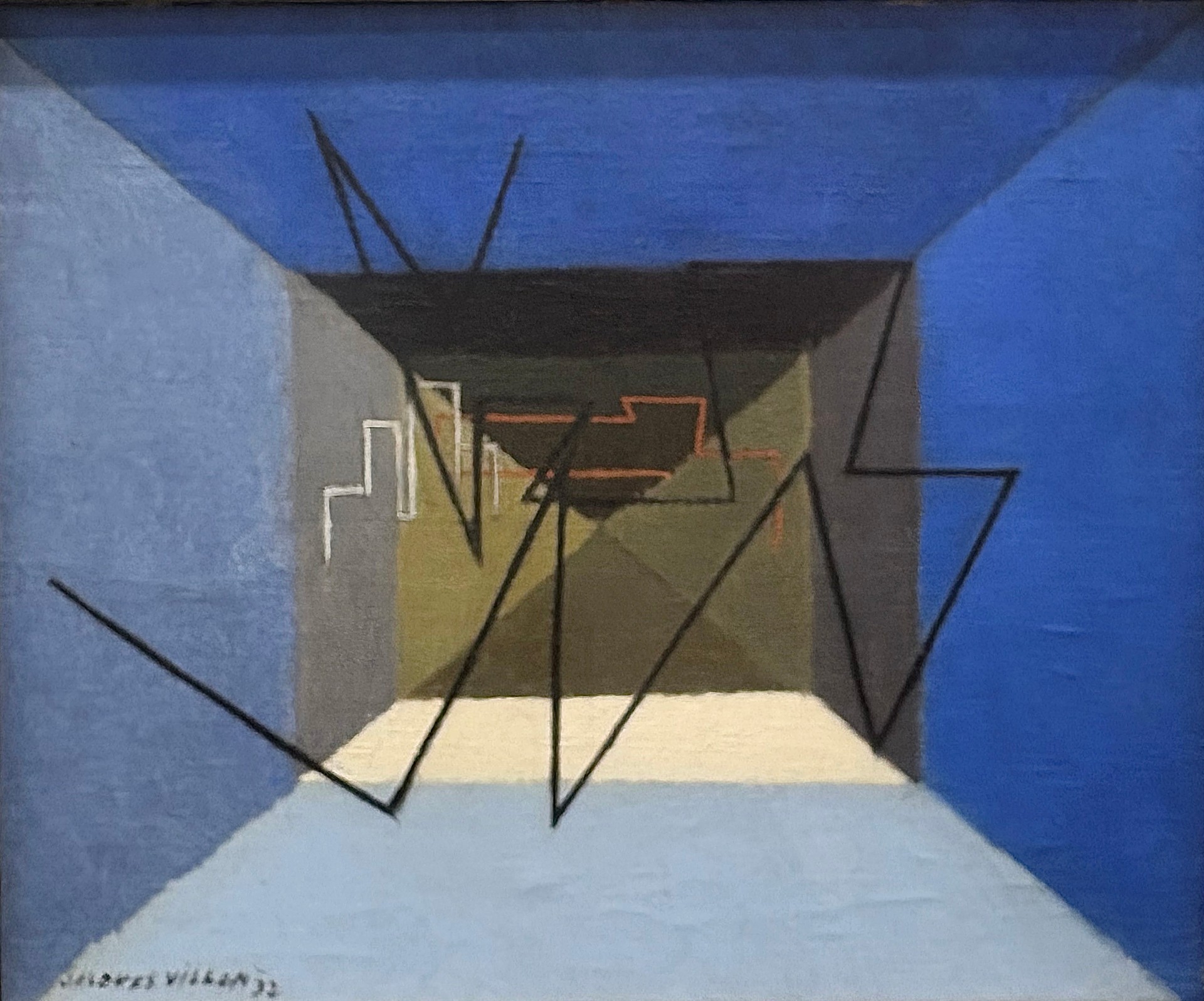

The unknown Duchamp Brothers
12/18/2025
6 min reading time
The SCHIRN is currently shedding light on Suzanne Duchamp’s oeuvre for the first time in a major retrospective, while her brother Marcel Duchamp has long since been part of the art history canon. Few know that there were two further Duchamp brothers who created key works. We explain!
Raymond Duchamp-Villon – the sculptor in the family
Raymond Duchamp-Villon (born Raymond Duchamp, 1876) was the sculptor among the Duchamp siblings and one of the artists who, at the beginning of the 20th century, clearly recognized that humankind had entered the Machine Age. Owing to his poor health, he had to discontinue studying medicine and was therefore able to completely dedicate himself to sculpting. He created some of the most unusual sculptures of his generation and without doubt emphatically influenced the history of modern art.
Duchamp-Villon was one of the members of the Cubist group of the Puteaux, artists who focused entirely on the plastic representation of movement and thus formed the contrasting foil to the analytical approach of the Montmartre Group round Georges Braque and Pablo Picasso. In 1911, he exhibited at the Salon d’Automne and impressed viewers with a highly simplified portrait before presenting his Cubist outlook with geometrically constructed busts. His interest in architecture and construction strongly informed his artistic output, as can be seen in the design for the façade of the La Maison Cubiste villa in Paris (1912).
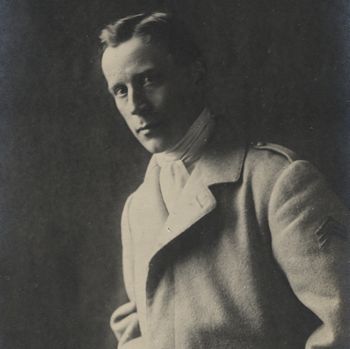

Painter Jacques Villon – better known than Marcel Duchamp?
What is just as amazing as Raymond Duchamp-Villon’s achievements as a sculptural pioneer and his siblings’ posthumous continuation of his life’s work is the artistic career of Jacques Villon (born Gaston Duchamp, 1875–1963). The eldest of the four siblings was at times probably better known in Europe than his now famous brother Marcel Duchamp, whose international breakthrough did not come until the 1960s.
As a co-founder of the Cubist Puteaux group and a board member of the Salon Automne, Villon played a strong part in trailblazing avant-garde exhibitions. At the same time, his inclusion in the Amory Show in 1913 in New York helped establish European Modernism in the USA. It seems somewhat obvious to assume that he therefore acted as a kind of role model for his younger siblings and paved the way for them, as it were.
Villon produced over 600 engravings and lithographs in total, whereby his work can initially be classified as Cubist. After Cubist portraits, such as that of his father produced in 1924, Villon’s paintings, with their intense colors, increasingly moved toward complete abstraction. Inspired by physicist Ogden Rood, Villon viewed color as a “weight on the scales of emotions” and as of the 1930s increasingly devoted himself to the theory of color. In his innumerable abstract works, he primarily arranged blocks of unadulterated color on flat surfaces in order to redefine notions of pictorial depth. He started exhibiting with the Parisian avant-garde group Abstraction-Création and continued to be held in high regard in the USA.
Villon was one of the leading masters of the École de Paris and in 1950 won first prize in the Carnegie International in Pittsburgh and the Grand Prize for Painting at the 1956 Venice Biennale. At this point in time, Jacques Villon was still the most popular member of the Duchamp family. Together with Marc Chagall and Roger Bissière, he designed the stained-glass windows for Metz Cathedral, and in 1963 he became the only member of this extraordinary family of artists to be made a Commander of the Legion of Honor. He died that same year.
In 1968, the works of Jacques Villon, Raymond Villon-Duchamp, Suzanne Duchamp, and Marcel Duchamp went on display together at Musée des Beaux-Arts in Rouen in the exhibition “Les Duchamps”; Marcel as the only still living sibling helped organize the show. They were evidently one another’s fiercest critics, but above all each always supported the others down their artistic paths. The relationships between the Duchamp siblings would appear not to have been ones of competition and instead to have hinged on deep mutual understanding and profound respect.