

What goes around comes around! 5 merry-go-round artworks – twixt enjoyment, abysses, and the future
09/09/2026
5 min reading time
Anyone who thinks merry-go-rounds are something only for kids – think again! Artists have circled the theme for ages. Sometimes it symbolizes childhood and new beginnings, at others war, social masquerades or the daily grind. In anticipation of Tim Otto Roth’s “Vocal Revolutions”, which runs from September 17–20, 2026, in SCHIRN, we go for a spin: with five extraordinary merry-go-round artworks.
1
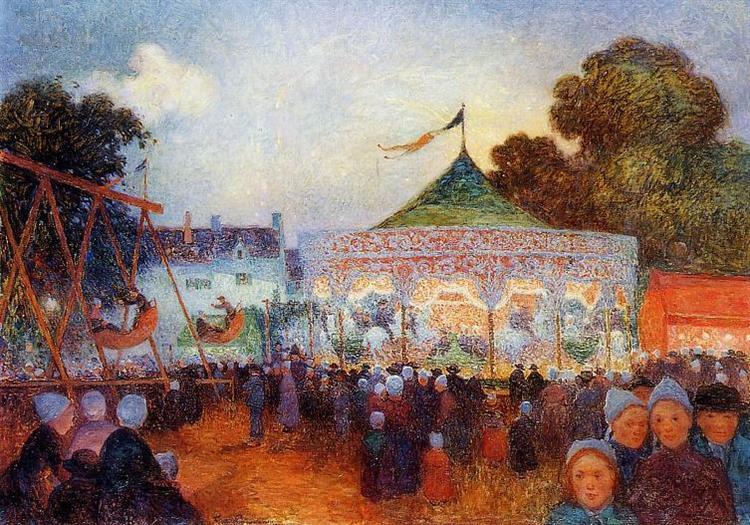
Ferdinand du Puigaudeau
Carousel at night at the fair (1898)
The merry-go-round in the limelight
In 1898, French painter Ferdinand du Puigaudeau placed the merry-go-round firmly in the center of things. In his scene of a fairground at night, it shines like a bright lodestar in the dark. The multiple layers of paint cause the lights to flicker and the crowd to dissolve into silhouettes. Puigaudeau records less an actual event and more a fleeting moment of collective joy. The merry-go-round becomes the symbol of a new leisure-time culture that brings people together for an enjoyable moment.
2
Mark Gertler
The Merry-Go-Round (1916)
A war in primary colors
Just under two decades later, the mood had changed. Mark Gertler painted “The Merry-Go-Round” in 1916, in the middle of World War I. People in uniform and civilian clothing sit together on the merry-go-round. The horses keep on turning, but the wide-open mouths seem like frozen screams. Even the brash primary colors do not serve to make the scene happier – on the contrary. For Gertler, who was a convinced pacifist, the fair becomes an oppressive metaphor for a war that has everyone in its clutches and seems not to allow any escape.


3
Ilse Bing
Carousel, Paris (1932)
When the merry-go-round stands still
In 1932, photographer Ilse Bing, a native of Frankfurt, pointed her Leica at a merry-go-round in Paris. The piece was commissioned by a Frankfurt newspaper for which Bing documented Paris and its public entertainment. However, there is no trace of pleasure to be seen here: no children, nothing moves, no leisurely relaxation. In the center we see a weathered horse that appears to have been frozen in mid-jump, while the other animals on the carousel disappear into the background. Harsh sunlight casts long shadows across the ground and the figures therefore look like so many independent sculptures. Bing crops the image sharply to transform the familiar decorations of the fair into a somehow remote and almost surreal scene that looking back brings to mind the political upheaval, crimes, and losses that were to shatter Europe only a few years later.

4
Keith Haring
Merry-go-round for Luna Luna (1987)
All aboard: Enjoy a ride!
Here, the merry-go-round itself becomes an artwork. For André Heller’s “Luna Luna” leisure park which opened in Hamburg in 1987 for the summer, Keith Haring designed a carousel that you could actually use. Visitors took their places on the bright pink, green, and orange seating figures, among them Haring’s famed “Radiant Baby” and barking dog. Here, art was not supposed to be viewed from some reverent distance but to take place in the middle of a fair. Haring was in great company: Jean-Michel Basquiat, Salvador Dalí, and Roy Lichtenstein all contributed attractions. After the Luna Park closed, the artworks disappeared for more than three decades into 44 containers in Texas. In 2023, “Luna Luna” returned as a restored exhibition, albeit now only according to the principle: View you may, ride you may not.

5
Tim Otto Roth
Vocal Revolutions (2026)
When only the movement remains
In the SCHIRN courtyard, the merry-go-round almost dissolves entirely. No horses, no chains of lights, no barrel organ. Instead, 36 spherical, gleaming loudspeakers on 12 cables revolve on three circular levels, above the audience’s heads, resembling a carousel light chain. With “Vocal Revolution,” artist and composer Tim Otto Roth uses pure sinus tones and noise to create an aural sculpture. We can thus hear how artificial intelligence generates voices and instrumental sounds. Even the light responds to the sound: Deep sounds glow red, high ones, blue. Gone is the classical carousel. But the principle continues to revolve, through movement, light, and sound.
“Vocal Revolutions” is on show at SCHIRN from Sept. 17 to 20, 2026, to mark the end of the exhibition “The World Through AI”. On Sept. 19 there will be an “Artist Talk” with Otto Roth and Kolja Reichert.
