10 Balloons, 40 Years of SCHIRN
04/16/2026
5 min reading time
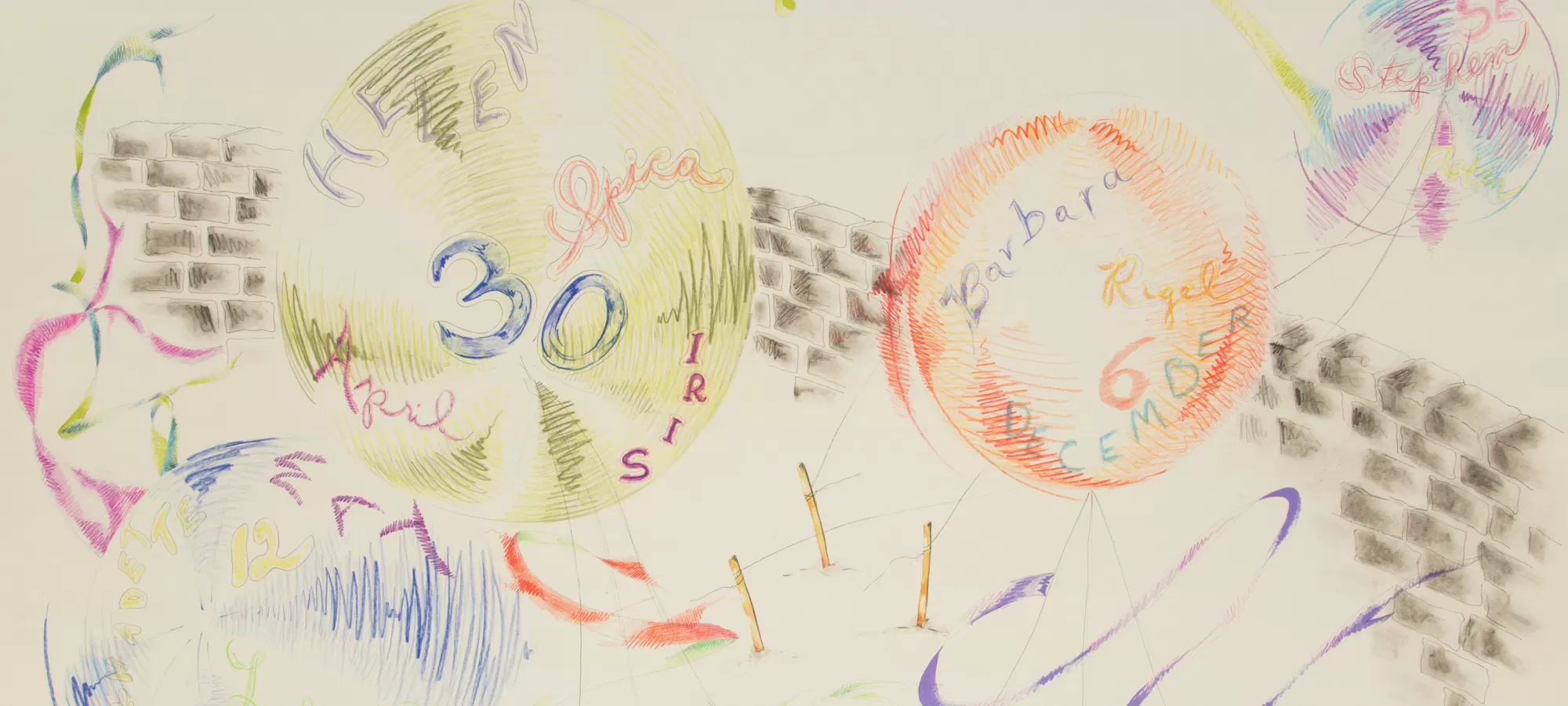
What would a birthday be without balloons? To mark its 40th anniversary, ten elaborately decorated white balloons will be installed at a special event at the SCHIRN in Bockenheim on May 9 and 10. The project is based on an ephemeral sculpture by Rosemary Mayer that connects the new location with the communities of Bockenheim.
The SCHIRN’s 40th anniversary is all about art and community. This is already evident in the many events for the anniversary weekend, but it is even more strikingly demonstrated by the artistic work of Rosemary Mayer. On May 9 and 10, the SCHIRN will present “Connections (Frankfurt),” an ephemeral art event dedicated to the connections – as the title suggests – between art, people, and places.
This participatory project was developed as early as 1978 by the US-American artist Rosemary Mayer. Born in New York in 1943, she began her career in the 1960s – a period of intense upheaval in which artistic forms of expression such as Minimalism, Conceptual Art, and performance art were establishing themselves and further evolving. Among the contemporaries in whose circle Mayer worked were well-known figures such as Sol LeWitt, Adrian Piper, and Richard Serra. She was also married for a while to the architect and installation artist Vito Acconci. Amid this dynamic scene, Mayer developed an independent artistic approach early on.

The Beauty of the Moment – Rosemary Mayer’s Temporary Monuments
While she devoted herself in the 1970s to wall-based works composed of multi-layered draped fabric panels, Mayer quickly turned to an increasingly performative and conceptual approach. She was particularly drawn to aspects of transience and temporality: as a result, her later projects are often characterized by their ephemeral nature and the use of transient materials – such as snow, wax, or helium balloons. Likewise, from the mid-1970s onward, she increasingly shifted her work into public space, where weather conditions and interaction with viewers had a direct impact on the work. For Mayer, however, these projects retained a sculptural character, even if they did not remain permanently in the space. She referred to them as “Temporary Monuments,” thereby expanding the then-prevailing forms of installation art – such as earthworks and post-minimalist works – to include a time-based, ephemeral dimension.
In addition, Mayer began to take a greater interest in the connections between people, places, and their stories. Rather than creating lasting objects, she became increasingly focused on making relationships visible – between personal experiences and collective memories, between space and time. Her aim was to use her art to facilitate encounters and to make community something that could be experienced as an open-ended, ongoing process. “Connections” combines Mayer’s ephemeral approach with her interest in community and encounters through and with art.