

The Uncanny is not dead –
5 artworks in which AI reinvents the uncanny
08/26/2026
5 min reading time

What happens if faces appear without having a biography, if machines remember and your own ego goes on living as a digital entity? Five artistic positions explore how AI shifts our notions of identity, memory, and reality. And show that the ‘Uncanny Valley’ is long since bigger than we thought.
1
Pierre Huyghe:
UUmwelt (2018)
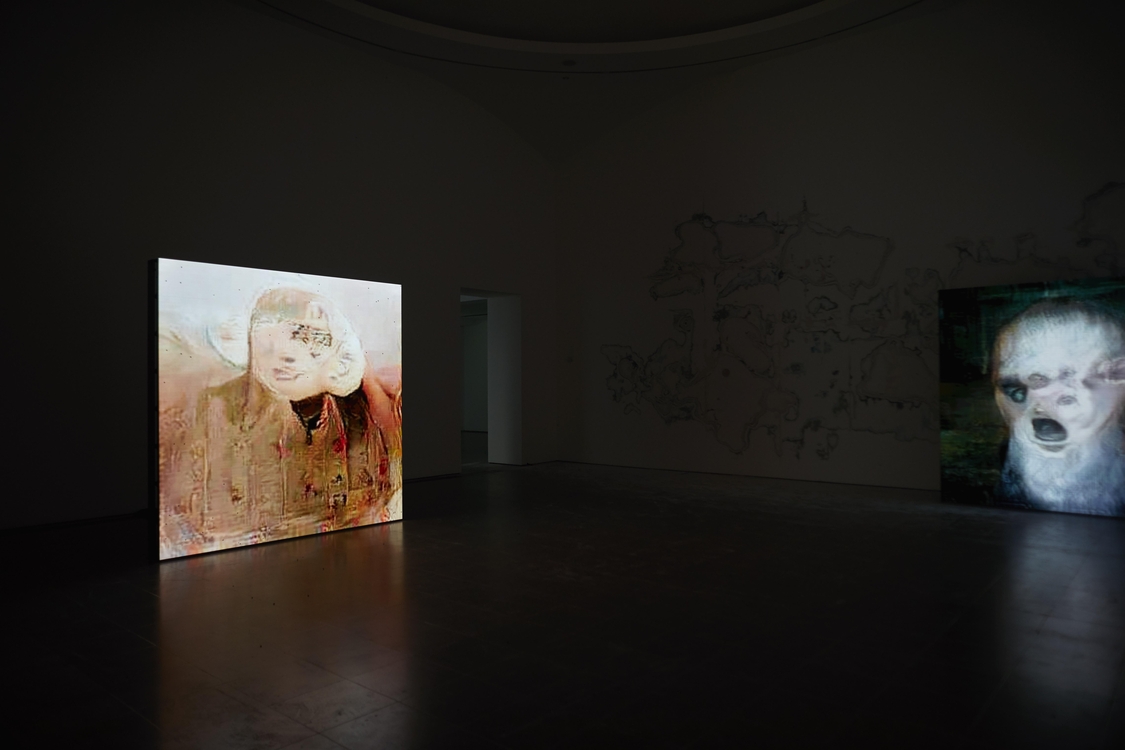
For “UUmwelt,” humans imagine certain motifs while their brain activity is recorded by a functional magnetic resonance tomograph. A neuronal network then reconstructs images from this. Onto the screens pop fleeting, unstable shapes: not what was actually imagined, but what the machine thinks the imagined looked like. The result is an uncanny interference. The inner world becomes visible without becoming really tangible. The activity of your thoughts is given a co-operative doppelgänger that is similar enough to the original to trigger irritation and strange enough in order to somehow escape us again.
2
Mario Klingemann:
Memories of Passersby I (2018)
In Mario Klingemann’s “Memories of Passersby I” you see faces that you feel you should somehow know. Perhaps from an old family photo album, perhaps from a museum, or perhaps from somewhere you once walked past. However, these people never existed. An AI continually generates new portraits in real time derived from historical worlds of images without their having ever been real. The faces appear, change, and disappear again. They are familiar without being known, intimate without being biographical. Precisely this is the basis of the new uncanniness of AI. It does not simply falsify reality; it generates familiarity without origin. You could term them ghosts from data, without ancestors and without families. You look into faces and suddenly notice: The unmistakable face evidently no longer requires human origins.

3
Louisa Clement:
Repräsentantinnen (2021)
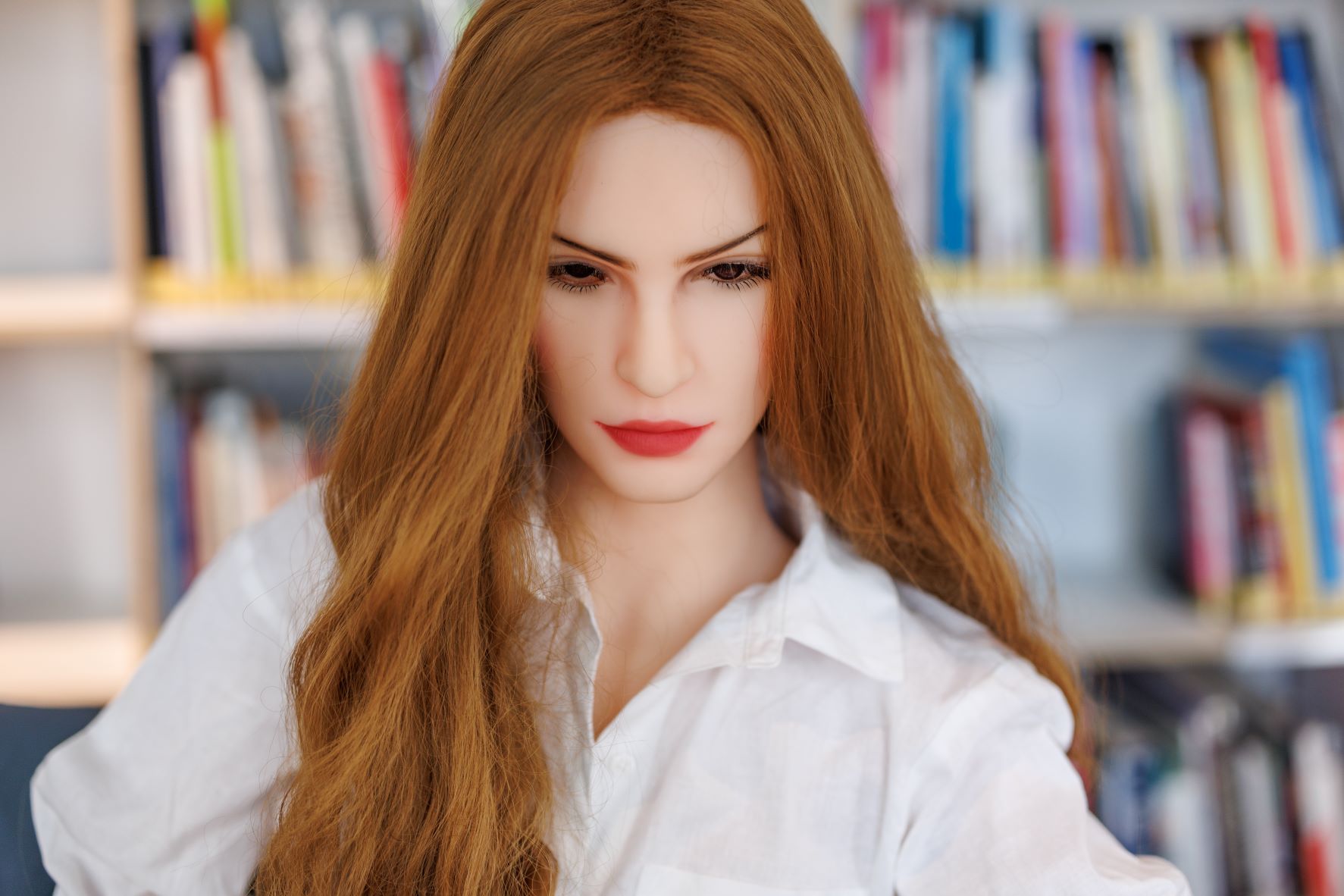
Louisa Clement’s “Representatives” are life-size real dolls modeled on her own body and outfitted with artificial intelligence. Clement answered more than 2,000 questions to ensure the doubles not only represent her visually, but can also articulate themselves, respond, and learn. It is an updating of the classical doppelganger, once a case for horror stories. For Clement, it is not just about being the same, but about delegation: Her own body becomes something outsourced, her personality a kind of interface. This becomes uncanny where the substitute does not merely serve as a representation but as a person opposite you. You are not standing in front of a doll but in front of a possible “yourself”. And it possibly answers differently than you would have done.
4
Holly Herndon & Mat Dryhurst:
xhairymutantx (2024)
Holly Herndon and Mat Dryhurst have created a figure that is person, meme, mutation, and myth all rolled into one. For “xhairymutantx” they trained an image model with distorted images of Herndon. The result are forever new variants on a figure that is organized around “Holly” but constantly distancing itself from her: red haired, hairy, human, animal, Siren-like, avatar-like. Here, the digital ego is no longer a mirror but a biotope. It grows rampantly, it frays at the ages, it continues to spawn itself. And as so often in the Internet, things don’t stop with this one work: The images thus generated circulate, get shared, stored, possibly in turn used as training material for other systems. Identity is in this way not simply represented, but written in real time. The uncanny stems from this strange situation: A person is still there yet also at the same time something that overtakes, overpaints, and reuses it.

5
Grégory Chatonsky:
The Fourth Memory (2025)
Memory was once categorized as looking back. That was comfy as one could at least claim that it had a firm link to the past. Grégory Chatonsky’s “The Fourth Memory” puts paid to that comfort zone. Generative AI comes up with alternative pasts, brings forth different versions of the artist, and deploys memory as something that does not merely preserve but as something that is produced. The work resembles a gravestone on an Earth bereft of humans and yet is anything but quiet. Something is forever returning, albeit not as a certainty but as a simulation. Freud was interested in how the repressed re-emerges; Chatonsky shows how something that has never existed inserts itself into life as if it had always been part of it. The AI remembers things that no one can remember. And precisely for that reason it seems so eerily plausible.
